
Change is not a disruption in corporate life.
It is the system operating as designed.
From your first day in a corporate job to your final leadership position, change will define your growth, test your capability, and expose your limitations. The professionals who rise are not those who avoid change. They are the ones who interpret it correctly.
This article breaks down change management in corporate professional life — not as a textbook framework, but as a career survival and growth strategy.
What Change Really Means in a Corporate Environment
Most professionals misunderstand change.
They think change is:
- A new manager
- A restructuring announcement
- A revised KPI
- A new software system
- A market downturn
But in reality, change is something deeper.
Change is the moment when your current capability becomes insufficient for your next expectation.
It is the gap between who you are today and who your role now demands you to become.
That gap creates discomfort.
And that discomfort is not punishment — it is professional evolution in progress.
Change Is Not an Event. It Is a Recurring Pattern.
If you observe your career carefully, you will notice cycles.
Every few years:
- Your responsibilities expand
- Performance standards increase
- Competition becomes sharper
- Market conditions shift
- Leadership expectations rise
Corporate environments reward those who grow faster than their environment changes.
When nothing changes for you for too long, that is not stability — it may be stagnation.
Growth introduces ambiguity.
Higher compensation introduces accountability.
Authority introduces scrutiny.
Change is not random. It is structural.
The real question becomes:
Are you growing at the same pace as your environment?
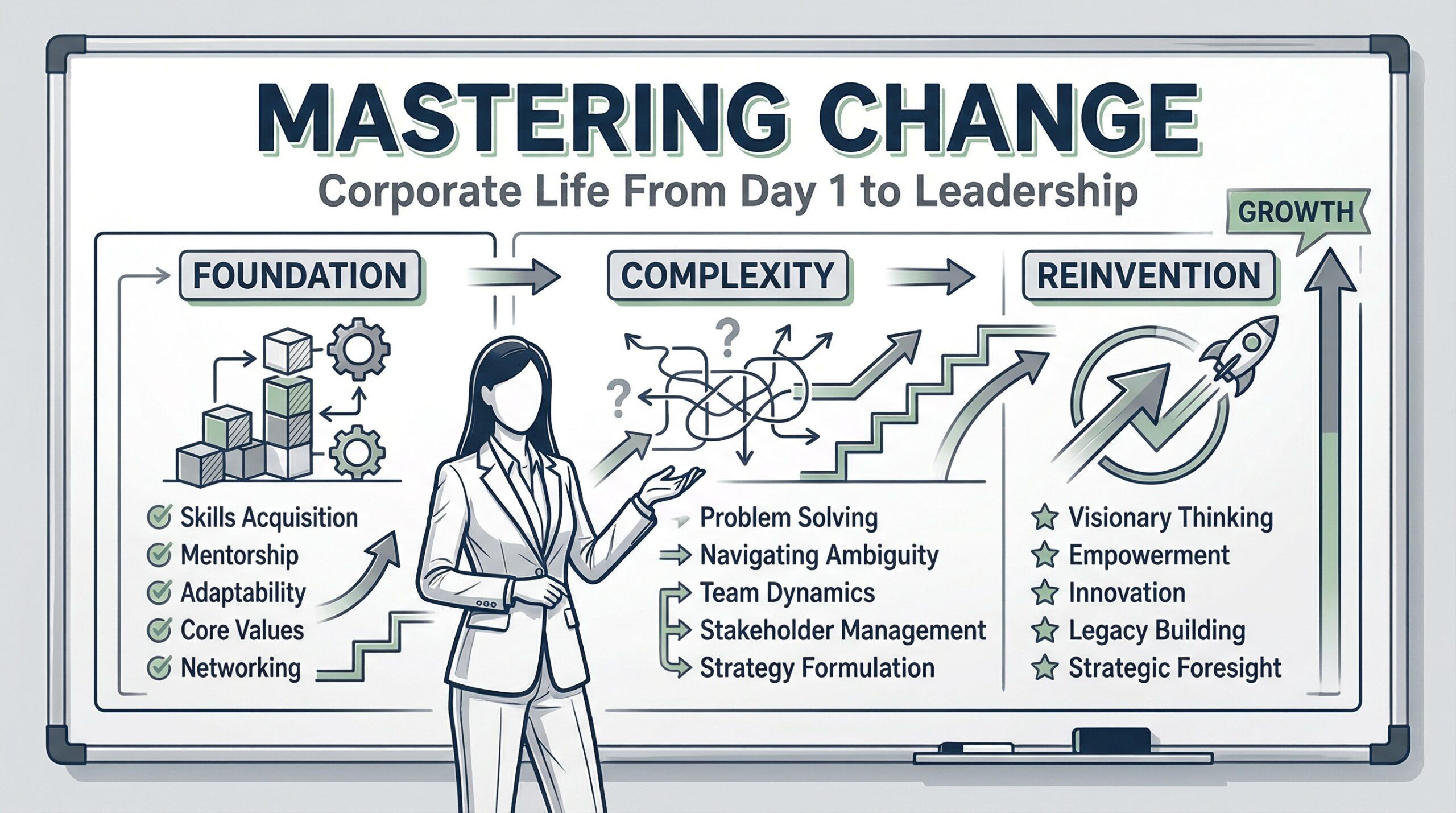
Change Management at Different Career Stages
Change does not feel the same at every stage of your professional journey. Its meaning evolves as your role evolves.
Watch the Full Video Breakdown
If you prefer a structured visual explanation with strategic narration, watch the full video version below:
Early Career (0–5 Years) — Change Builds Your Foundation
In the early years of your corporate life, change feels overwhelming.
Everything is unfamiliar:
- Systems
- Terminology
- Performance pressure
- Feedback culture
- Corporate politics
At this stage, change is shaping your professional identity.
You are not hired for authority.
You are hired for execution potential.
Change here builds three foundational capabilities:
1. Learning Agility
How quickly can you adapt to unfamiliar tasks?
2. Emotional Stability
Can you accept correction without ego damage?
3. Discipline
Can you deliver consistently under ambiguity?
Early-career professionals often interpret change as unfair pressure. In reality, the organization is testing reliability.
Your reaction to change becomes your reputation.
Adaptability earns trust.
Resistance builds limitations.
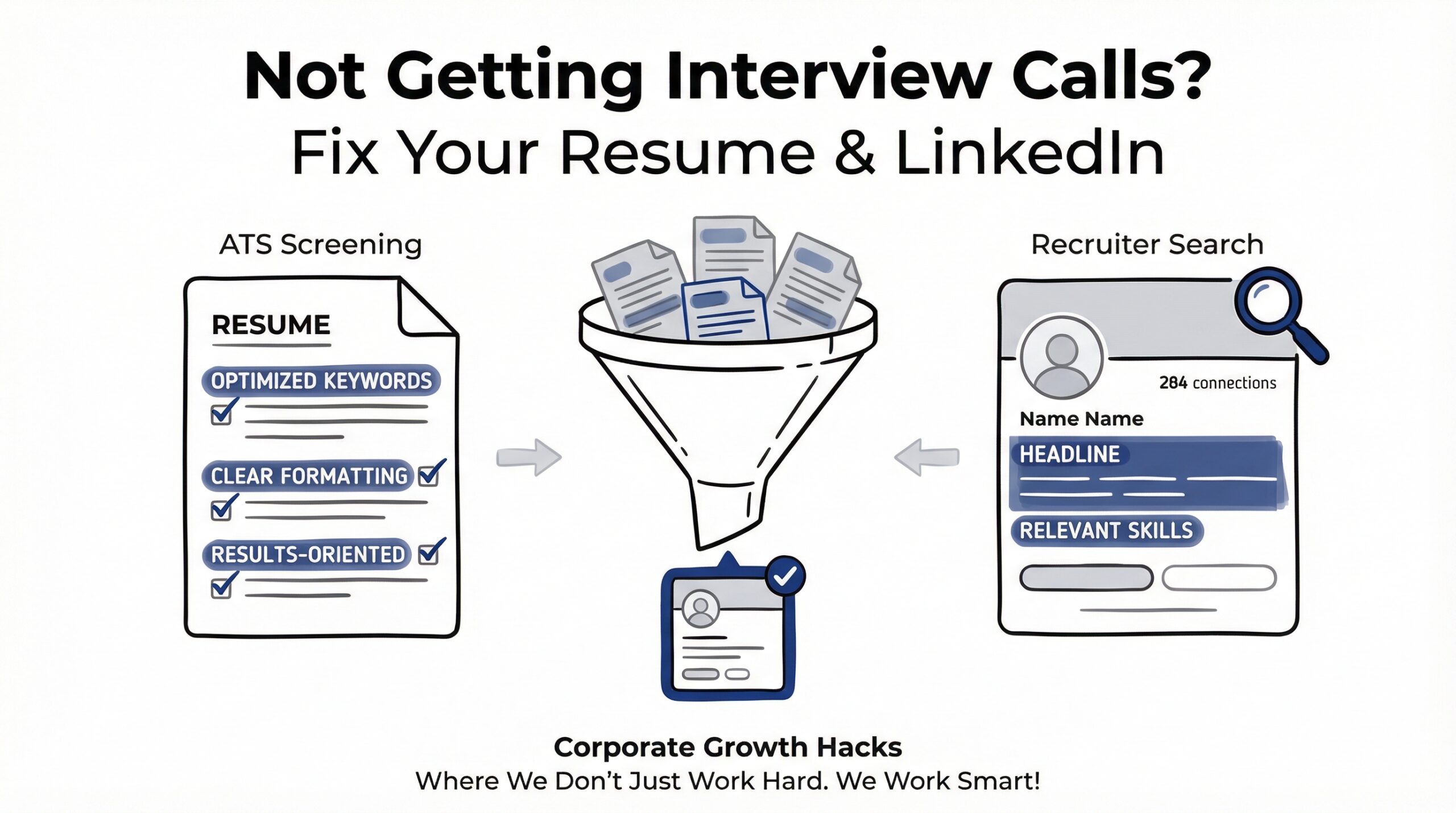
If you’re in your early professional years, you may also benefit from our guide on
Fixing Your Resume and LinkedIn for Interview Calls – Optimize your Linkedin & Resume
Mid-Career (6–15 Years) — Change Becomes Complex
Mid-career change is not about task difficulty.
It is about complexity.
Now you manage:
- Teams
- Budgets
- Stakeholders
- Performance metrics
- Organizational politics
The question shifts from “Can you do the work?” to “Can you manage uncertainty while others depend on you?”
At this stage:
- Authority increases
- Visibility increases
- Exposure increases
And so does pressure.
You may need to:
- Deliver results with limited resources
- Align teams around unpopular decisions
- Communicate difficult realities upward
- Navigate political tensions carefully
Mid-career change tests emotional intelligence more than technical skill.
Professionals who master complexity rise into leadership.
Professionals who complain about complexity plateau.
Senior Career (15+ Years) — Change Tests Relevance
At senior levels, change is no longer operational.
It is existential.
Markets evolve.
Technology disrupts.
Younger professionals bring new thinking.
Business models transform.
Authority is high.
But replacement risk is also high.
Senior professionals must answer one critical question:
Can you reinvent without losing your strategic core?
Relevance at this stage requires:
- Continuous learning
- Humility
- Adaptability
- Forward-thinking leadership
Leadership is not about controlling change.
It is about guiding others through it with stability.
Your response to change at this stage defines your legacy.
The Psychology of Change — Why It Feels Threatening
Change challenges predictability.
And predictability creates psychological comfort.
When change disrupts structure, it triggers fear — not because you are incapable, but because certainty disappears.
Instead of reacting emotionally, build a reframing discipline:
Ask:
- What capability gap is being exposed?
- What behavior must evolve?
- What opportunity is hidden here?
Professionals who treat change as data outperform those who treat it as drama.
Emotional reaction delays growth.
Strategic reflection accelerates it.
Practical Change Management Strategy for Corporate Professionals
Mental resilience alone is insufficient.
You need structural preparation.
Download the Corporate Change Readiness Checklist (Free)
If you want a structured framework to evaluate your readiness for corporate change, download our free Corporate Change Readiness Checklist.
This checklist helps you assess:
• Skill adaptability
• Emotional resilience
• Leadership exposure
• Financial preparedness
• Network strength
Download it here: Corporate Change Readiness Checklist
Continuous Skill Upgrade
Never wait for disruption to learn.
If your skills remain static while your industry evolves, change will feel threatening instead of empowering.
Relationship Capital
Strong internal and external networks reduce career risk.
Change isolates those who operate alone.
Physical Resilience
Stress tolerance is a competitive advantage.
High-responsibility roles demand energy, clarity, and stability.
Financial Stability
A financial cushion reduces panic-driven decisions during uncertainty.
Change is easier to manage when survival pressure is low.
Financial preparedness is a silent advantage in corporate life. You can read our structured framework in Basic Financial Planning for Working Professionals – Financial planning for working professionals
Authority vs Accountability — The Hidden Equation
As you grow in corporate life, authority and accountability rise together.
Many professionals chase authority.
Few prepare for the accountability that comes with it.
Change intensifies this equation.
If your authority grows faster than your capability, exposure increases.
If your capability grows faster than your authority, leadership eventually follows.
Balance is critical.
Final Perspective — Change Is Not the Enemy
Change is constant.
That is not unfortunate.
That is structural.
Discomfort signals expansion.
Uncertainty signals growth potential.
Challenge signals elevation.
You cannot eliminate change from corporate life.
But you can master your response to it.
And that mastery becomes your competitive advantage.
Corporate Growth Hacks Perspective
At Corporate Growth Hacks, we believe:
Growth is not accidental.
It is intentional.
Change is not something to fear.
It is something to interpret strategically.
Smart professionals do not simply work hard.
They work smart — especially when the environment shifts.
If this perspective strengthened your thinking, explore more insights on corporate strategy, professional development, and leadership growth across CGH.
For structured insights on corporate strategy, career positioning, and leadership growth, explore the Corporate Growth Hacks YouTube Channel.
Visit here: Corporate Growth Hacks YouTube Channel
Because in corporate life, the advantage does not belong to the loudest. It belongs to the most adaptable.