
In the professional world, one of the most misunderstood skills is the ability to say no.
Many professionals believe that career growth comes from saying yes to everything — every task, every request, every deadline.
At first glance, this behavior seems admirable. It signals commitment, dedication, and a willingness to contribute.
But over time, something else begins to happen.
Your workload keeps increasing.
Your responsibilities keep expanding.
And slowly, you begin to realize that your professional life is becoming increasingly difficult to manage.
The uncomfortable truth is that many professionals do not struggle with work because they are incapable.
They struggle because they never learned how to say no in a professional environment.
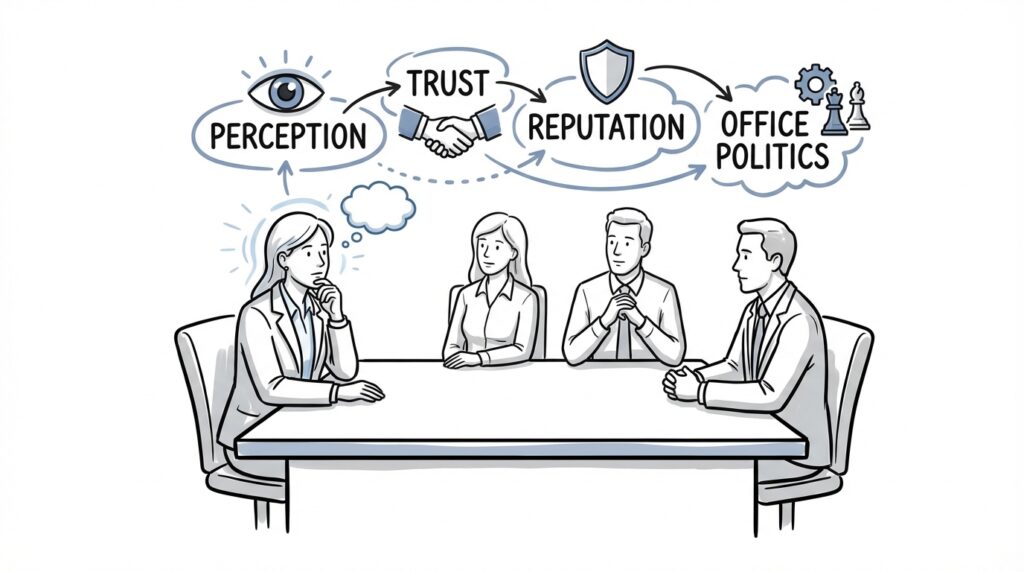
However, saying no in the workplace is not as simple as refusing a request. Corporate environments operate on relationships, perception, and trust. A poorly handled refusal can create long-term reputational damage.
This is why the real skill is not simply saying no, but understanding how to say no intelligently, diplomatically, and strategically.
This article explores the deeper dynamics behind workplace requests and provides practical approaches to declining work without damaging your career trajectory.
If you prefer watching insights explained visually, I’ve also shared a detailed breakdown of this topic in the video below.
How Do You Say No at Work Professionally?
Saying no at work professionally means acknowledging the request, explaining your current priorities, and suggesting an alternative solution. Instead of refusing abruptly, experienced professionals negotiate timelines, clarify priorities, or redirect work to the appropriate team. This approach protects professional relationships while maintaining healthy workload boundaries.
Why Saying “No” at Work Is More Complex Than It Appears
In theory, modern organizations encourage open communication and transparency.
In practice, workplaces operate within a framework of professional perception.
Whenever someone assigns you work, they are evaluating more than just your ability to complete the task. They are also unconsciously assessing several characteristics:
- Are you dependable?
- Are you cooperative?
- Are you someone who helps move work forward?
- Or are you someone who creates resistance?
Because of this dynamic, a blunt refusal can easily create the impression that you are difficult to work with.
Even when your reasoning is valid, the perception of resistance can quietly shape how colleagues and managers evaluate you over time.
Corporate reputations rarely change through dramatic moments. They are built gradually through small, repeated signals of behavior.
This is why experienced professionals rarely respond to requests with a direct “no.” Instead, they redirect, reframe, or negotiate the request in a way that maintains collaboration while protecting their own workload.
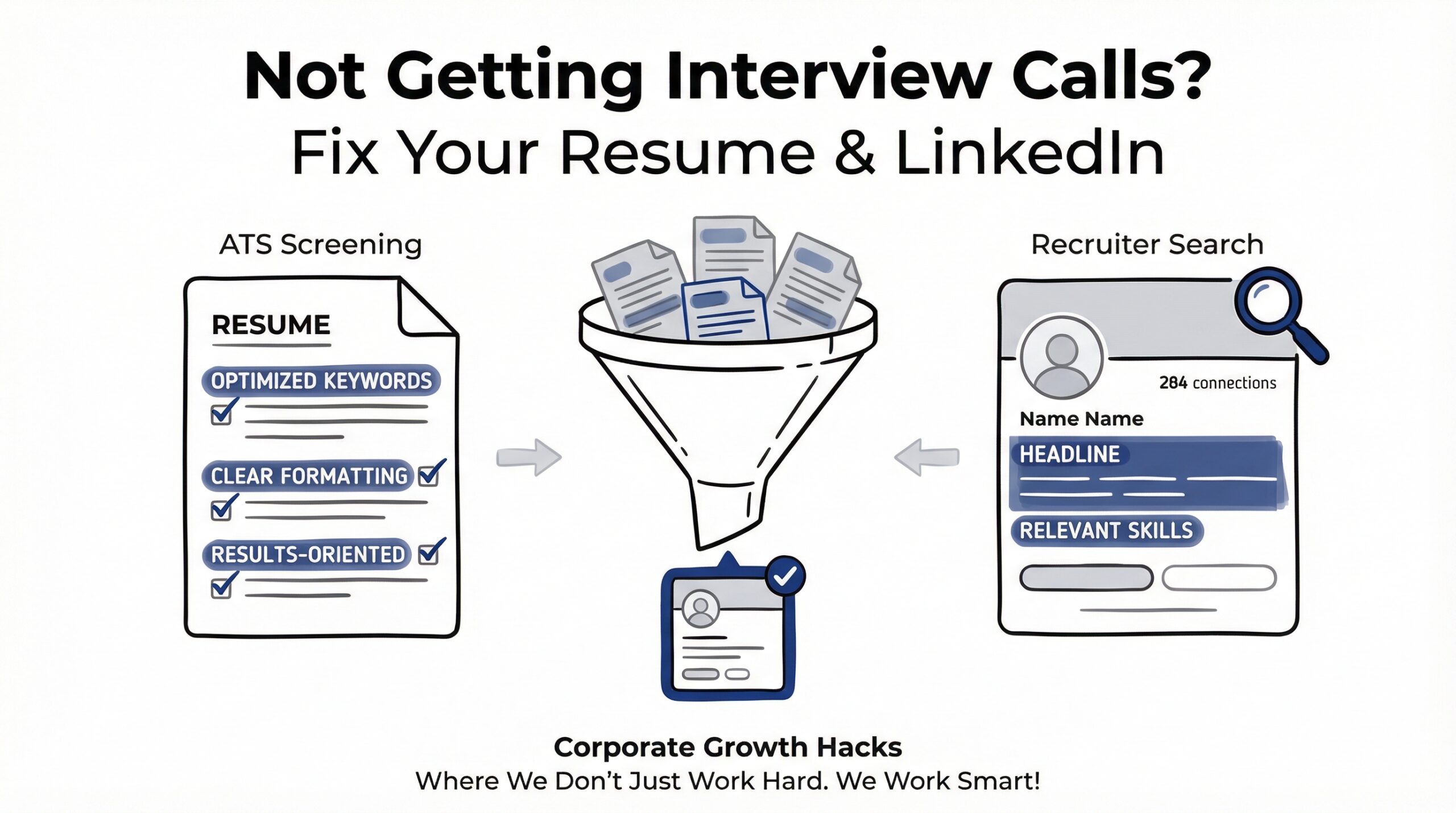
Building a strong professional reputation is not only about managing workload and communication. It also depends on how you present your professional experience and achievements. If you are looking to strengthen your career positioning, you may also find this guide on resume optimization helpful.
Understanding this nuance is essential for long-term professional success.
The Hidden Risk of Always Saying Yes
At the other extreme, many professionals never refuse work.
They accept every request that comes their way, believing that this demonstrates dedication.
Unfortunately, this approach often creates unintended consequences.
Declining Work Quality
When responsibilities accumulate beyond manageable levels, even highly capable professionals struggle to maintain the same level of quality in their work.
Deadlines become stressful, attention to detail declines, and tasks begin to feel rushed.
Invisible Overload
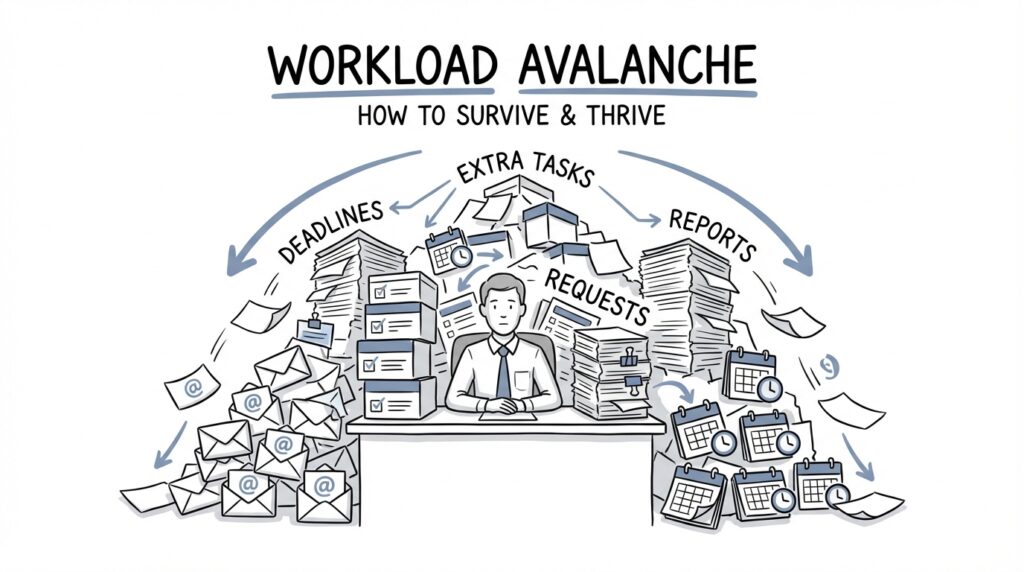
Ironically, managers and colleagues often do not realize when someone is overloaded.
If you consistently accept new responsibilities without discussion, the assumption becomes that you have capacity to handle more work.
This leads to a cycle where additional tasks are assigned continuously.
Long-Term Burnout
Over time, constant overload leads to exhaustion, disengagement, and reduced motivation.
Many professionals eventually reach a point where they feel trapped in a workload that seems impossible to control.
The problem is not necessarily the organization.
The problem is that boundaries were never established.
Why Silent Suffering Is Not a Career Strategy
Some professionals believe that enduring excessive workload silently will eventually be recognized and rewarded.
Unfortunately, corporate environments rarely function this way.
Organizations reward impact, clarity, and results, not silent endurance.
When you accept everything without communicating constraints, two assumptions often emerge:
- You are capable of handling the workload.
- The workload is reasonable.
As a result, the cycle continues. Learning how to communicate boundaries professionally is not an act of defiance. It is an essential skill for maintaining sustainable performance and long-term career health.
The Smart Way to Say No at Work
The key to declining work professionally is to avoid framing the response as a rejection.
Instead, the response should be positioned as a discussion about priorities, capacity, and outcomes.
Here are several practical approaches that experienced professionals often use.
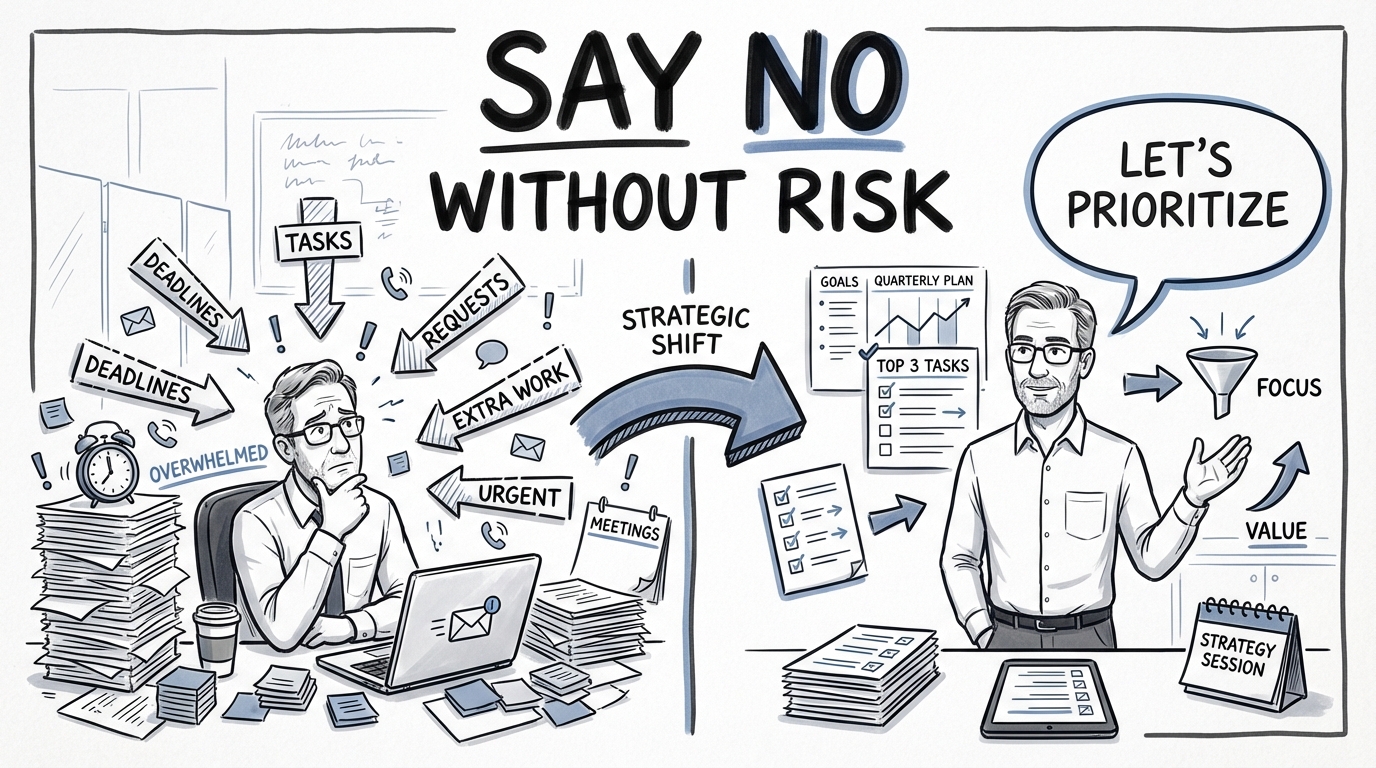
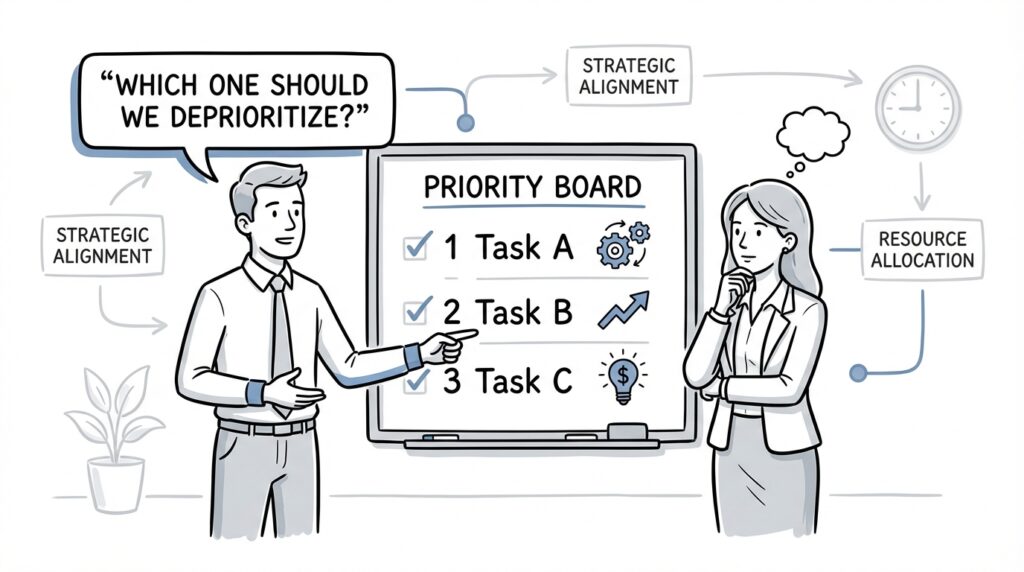
1. The Prioritization Method
One of the most effective ways to push back on additional work is to highlight existing priorities.
Instead of refusing the request, present the current workload and ask for clarification on priorities.
For example:
“I’m currently working on three deliverables scheduled for this week. If this new task needs to be added, which of the existing priorities should move down?”
This approach achieves several objectives simultaneously:
- It shows willingness to help
- It makes the workload visible
- It encourages leadership to make the prioritization decision
Most importantly, it avoids direct confrontation.
2. The Timeline Negotiation Approach
Sometimes the task itself is reasonable, but the timeline is unrealistic.
In such cases, the most effective response is not to refuse the work but to negotiate the timeline.
A professional response might sound like:
“I can definitely support this initiative. To complete it properly alongside my current responsibilities, I would need an additional two days.” This positions the conversation around quality and feasibility, which are far more constructive topics than refusal.
3. Redirecting Work to the Right Team
In large organizations, tasks are sometimes assigned to individuals or teams that are not best positioned to complete them.
When this happens, a constructive redirection can help maintain efficiency.
For example:
“This looks closely aligned with the analytics team’s current projects. It may move faster if they take the lead, and I would be happy to support where needed.”
The tone remains collaborative while ensuring responsibilities are distributed appropriately.
How to Say No to Different People at Work
The way you handle a request also depends on who is making the request.
Different workplace relationships require different communication strategies.
Saying No to Colleagues
With peers, the goal is to maintain positive working relationships.
Honest communication combined with flexibility works best.
For example:
“This week is quite full with project deadlines. If this can wait until next week, I can give it proper attention.” Peers generally appreciate clarity when it is communicated respectfully.
Saying No to Your Team
When a subordinate approaches you with a request that can be solved independently, the goal should be development rather than refusal.
Instead of immediately solving the problem, encourage them to think through possible solutions.
For example:
“What approaches have you already considered? Let’s review them together.” This approach builds confidence and capability within the team.
Saying No to Your Manager
Refusing a request from a manager requires the most diplomacy.
Direct refusal can easily be misinterpreted.
Instead, frame the conversation around priorities.
For example:
“I’m happy to take this on. I just want to confirm which of the current priorities should shift to accommodate this.” This keeps the decision aligned with leadership expectations.
Modern organizations constantly deal with shifting priorities, evolving strategies, and internal transitions. Understanding how organizations manage change can also help professionals navigate workplace expectations more effectively. Review our guide on change management in organizations to help you understand it better.
The Long-Term Impact of Professional Boundaries
Over time, how you manage workload conversations shapes your professional identity.
If you consistently accept everything without discussion, colleagues may begin to view you as someone who can always absorb additional responsibilities.
If you reject requests abruptly, you may be perceived as uncooperative.
However, when you communicate thoughtfully about priorities and capacity, something different happens.
People begin to see you as someone who understands how work should be structured and managed.
This reputation often leads to greater trust and responsibility.
Leaders are not simply looking for people who can work hard. They are looking for individuals who can navigate complexity and make balanced decisions.
Final Thoughts: The Balance Between Yes and No
The word no should never be used casually in professional environments.
Every request exists within a broader context of relationships, expectations, and long-term career dynamics.
Sometimes saying yes builds goodwill that strengthens your professional network.
Sometimes saying no protects your time, your health, and the quality of your work.
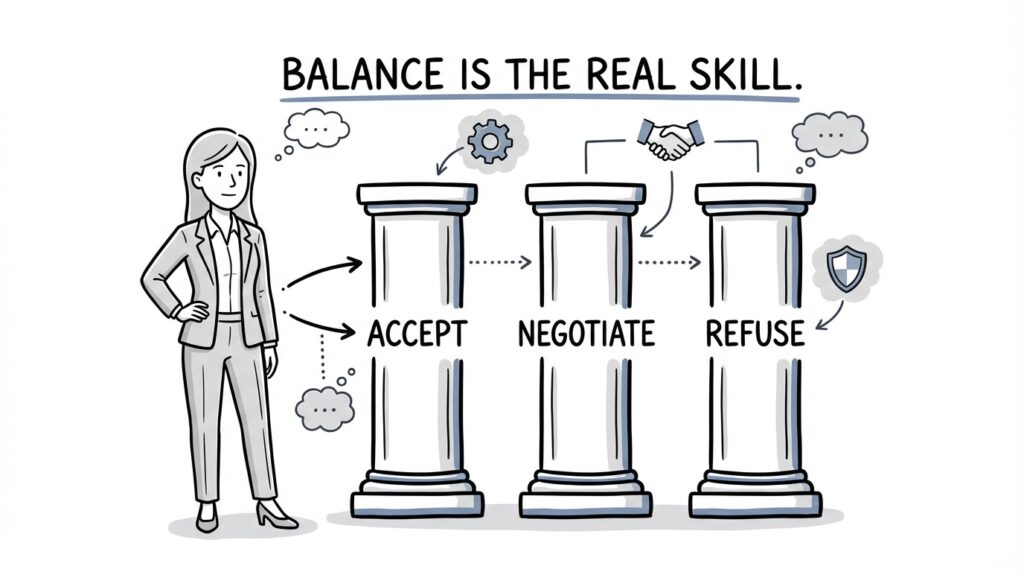
The real skill lies in understanding when to accept, when to negotiate, and when to decline.
Professionals who master this balance rarely feel overwhelmed by work.
Instead, they develop a reputation for thoughtful judgment, strategic thinking, and reliable execution.
And in the long run, those qualities matter far more than simply being the person who always says yes.
About CGH
CGH focuses on the deeper realities of professional life — the lessons that are rarely discussed openly but become clear through experience.
Because in modern organizations, success is not only about working harder.
It is about learning how to work smarter.
If you found this article helpful, you can explore more discussions on corporate life, workplace strategy, and career growth on the CGH YouTube channel.
Frequently Asked Questions About Saying No at Work
Is it okay to say no at work?
Yes, it is acceptable to say no at work when requests exceed your capacity or conflict with existing priorities. The key is to communicate professionally, explain your workload, and suggest alternative solutions instead of refusing abruptly.
How do you politely decline extra work?
You can decline extra work by acknowledging the request and clarifying your current priorities. For example, explain what you are currently working on and ask which tasks should be deprioritized if the new request needs to be accommodated.
How do you say no to your boss professionally?
Instead of saying no directly, discuss priorities. A professional response might involve asking which existing responsibilities should shift to make room for the new request.
Why is saying no difficult in corporate environments?
Saying no can be difficult because workplace dynamics involve reputation, trust, and collaboration. Professionals often worry that refusal may be interpreted as resistance or lack of teamwork
For readers who prefer practical tools, I have also shared free checklists that can help professionals structure their career strategy and understand workplace dynamics more clearly.
You can download the free resources from the CGH download section.