
Every week, I speak to professionals who say:
“I’ve applied to 100+ jobs. I’m not getting interview calls.”
Most of them are skilled.
Many are experienced.
Almost all of them are frustrated.
But the uncomfortable truth is this:
You are not rejected because you lack capability.
You are rejected because you are not positioned correctly.
Corporate careers are not just about deserving.
They are about visibility and clarity of value.
Let’s break this down properly.
1. The Recruiter Screening Reality (Most Professionals Ignore This)
Before you blame the market, understand the system.
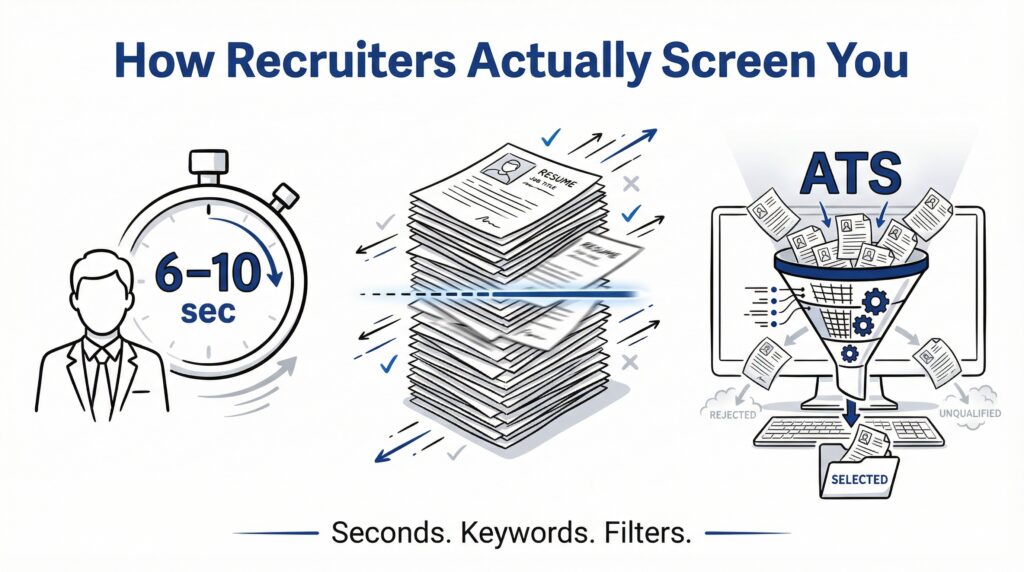
Recruiters spend 6–10 seconds scanning a resume.
Not minutes. Seconds.
They are not reading your story.
They are scanning for:
- Role relevance
- Measurable impact
- Keywords
- Industry alignment
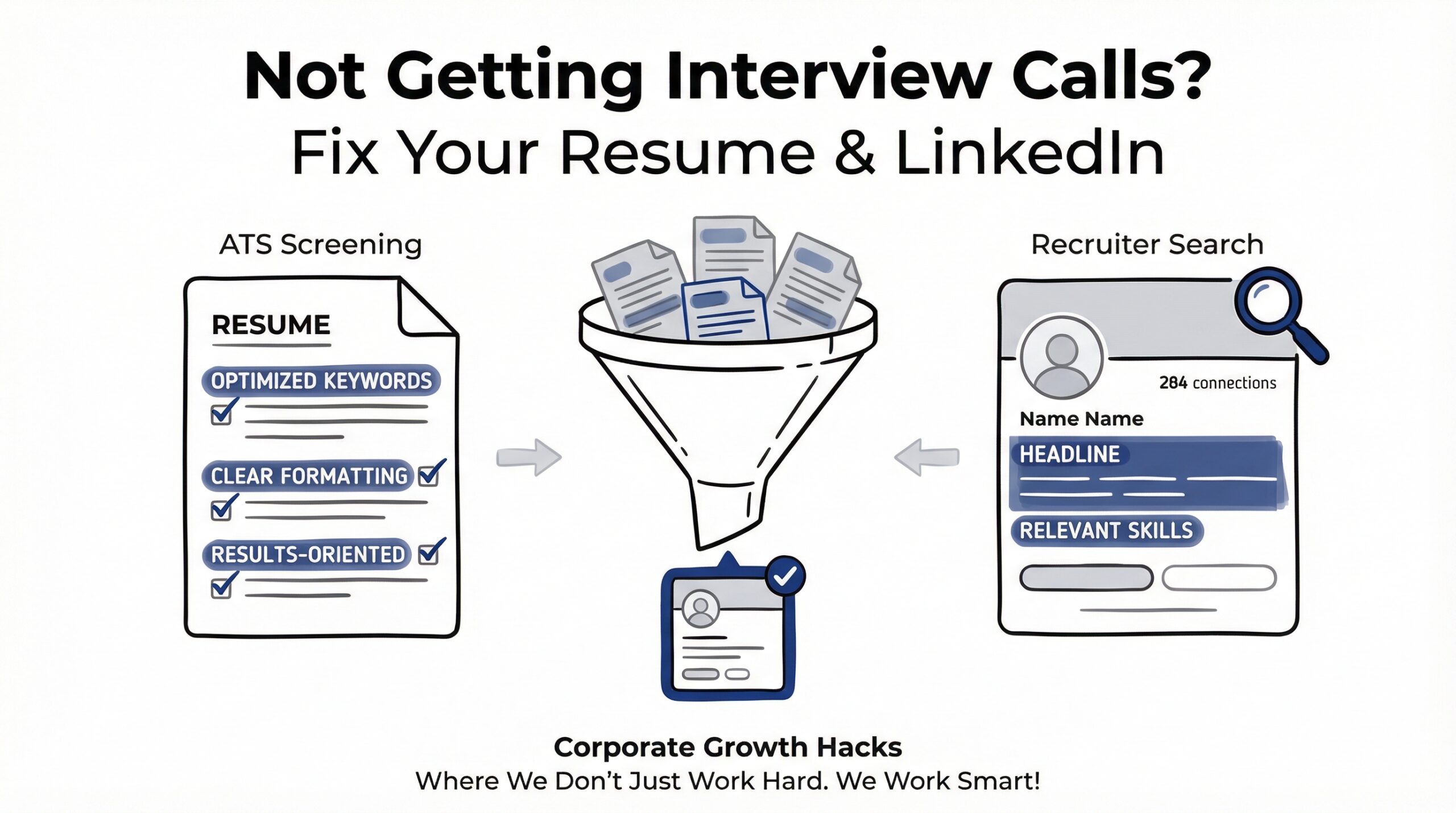
And before your resume even reaches a recruiter, there’s another gatekeeper:
ATS (Applicant Tracking Systems)
Most companies use ATS software to filter resumes based on:
- Job title keywords
- Tools and skills
- Industry terminology
- Match percentage with job description
If your resume does not contain the right keywords,
it may never be seen by a human.
The same applies to LinkedIn.
Recruiters don’t scroll randomly.
They search.
If your profile does not match the search terms they use,
you are invisible.
This is not unfair.
It is structured filtering.
And once you understand that, you can work with it.
Part 1: Resume Mistakes That Kill Interview Calls
Mistake 1: Copy-Pasting Job Responsibilities
Most resumes look like this:
- Responsible for team management
- Handled operations
- Managed client relationships
That tells me what your job was.
It does not tell me what you achieved.
Your resume is not a job description.
It is a performance document.
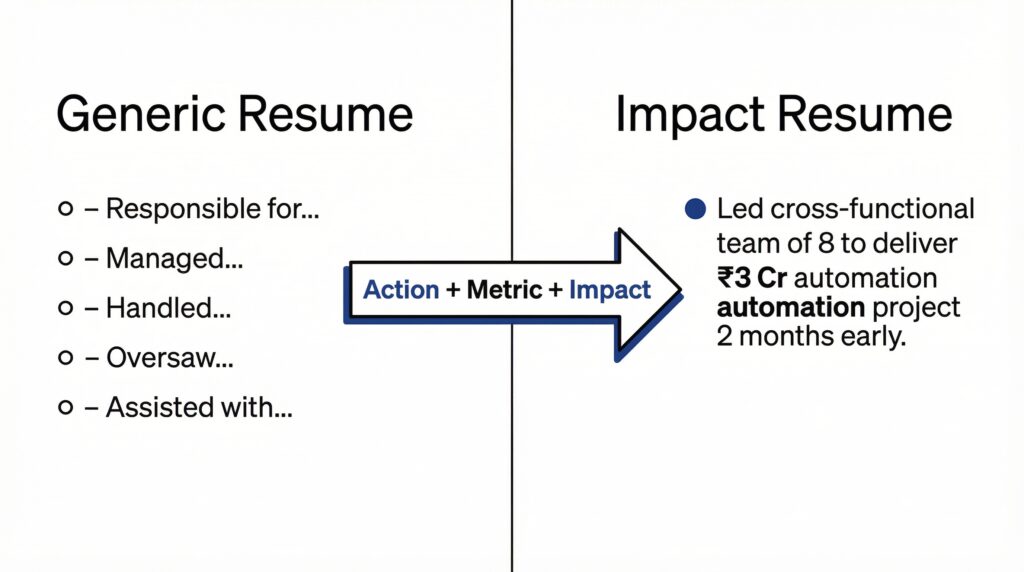
Use This Formula Instead:
Action + Metric + Impact
For example:
Led cross-functional team of 8 to deliver ₹3 crore automation project 2 months ahead of schedule.
Now I can see:
- Scope
- Leadership
- Financial impact
- Execution capability
Numbers build credibility.
Metrics signal seriousness.
Impact builds authority.
If your resume has no measurable outcomes,
it looks generic — even if your work was not.
Mistake 2: One Resume for All Jobs
This is one of the biggest mistakes I see.
Professionals create one resume and send it everywhere.
That approach does not work anymore.
Every serious application requires customization.
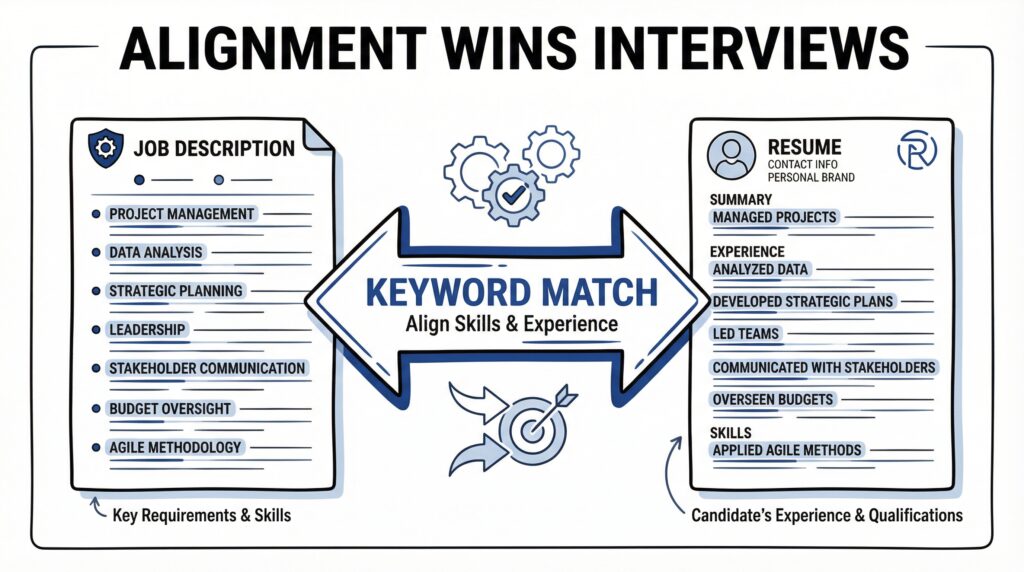
Study the job description and ask:
- What tools are mentioned repeatedly?
- What keywords are emphasized?
- What business outcomes are expected?
Then naturally incorporate those terms into your resume —
only where relevant.
You are not faking experience.
You are aligning language.
Recruiters think in keywords.
Your resume must speak that language.
Part 2: LinkedIn Mistakes That Reduce Your Visibility
If your resume is your formal pitch,
LinkedIn is your public positioning platform.
And most professionals treat it casually.
Mistake 3: Weak or Generic Headline
Your headline is not your job title.
“Manager at XYZ Company” tells me nothing.
Your headline should clearly communicate:
- Role
- Expertise
- Industry
- Value proposition
For example:
Operations Leader | Supply Chain Optimization | Cost Reduction Specialist | Manufacturing Industry
Within seconds, I know:
- What you do
- What you specialize in
- Where you operate
Clarity builds credibility.
Mistake 4: Incomplete Profile and Zero Activity
An incomplete LinkedIn profile signals low seriousness.
And zero activity reduces visibility.
You don’t need to become a content creator.
But you should:
- Comment thoughtfully on industry posts
- Share insights occasionally
- Engage with relevant discussions
Three meaningful engagements per week is enough.
Why?
Because visibility builds familiarity.
Familiarity builds trust.
And trust increases opportunities.
Mistake 5: No Keyword Optimization on LinkedIn
Here is a simple exercise.
Search your target job title on LinkedIn.
Look at the top profiles that appear.
Study:
- Their headlines
- Their “About” sections
- The language used in experience descriptions
Notice the keywords.
Now ask yourself:
Are those keywords present in your profile?
If not, you are not aligned with search intent.
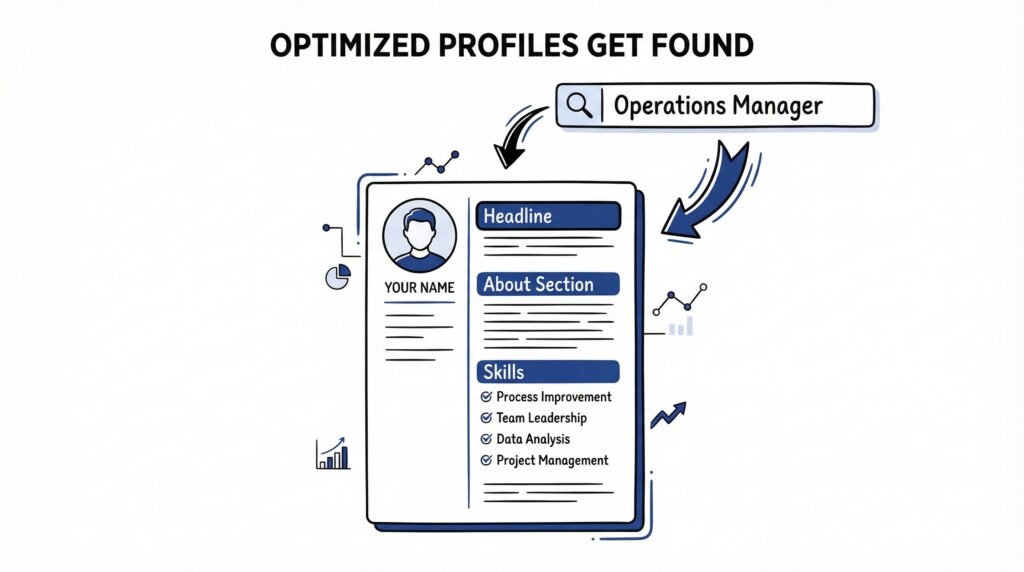
Naturally integrate relevant keywords into:
- Headline
- About section
- Experience
- Skills
LinkedIn is a search engine.
Treat it like one.
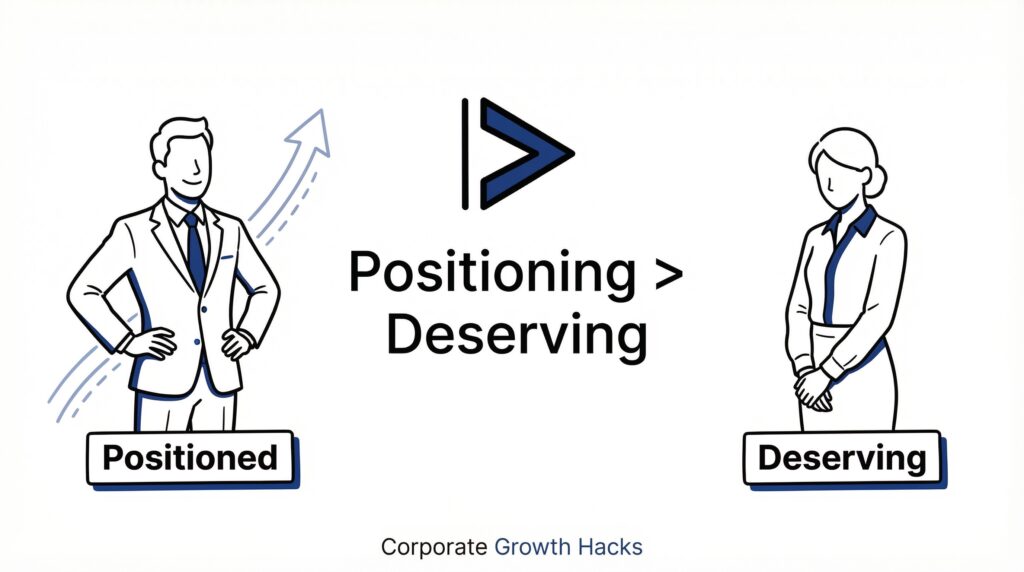
The Bigger Truth: Positioning Over Deserving
Many professionals say:
“I deserve better opportunities.”
Maybe you do.
But corporate systems do not reward silent competence.
They reward visible value.
Your resume and LinkedIn are not biographies.
They are marketing documents.
This does not mean exaggeration.
It means:
- Structuring achievements clearly
- Highlighting impact
- Communicating value in business terms
If you cannot articulate your contribution,
the market cannot recognize it.
The 5-Step Action Plan
If you want immediate direction, follow this:
1. Rewrite resume bullets using Action + Metric + Impact.
2. Tailor your resume for every serious application.
3. Optimize your LinkedIn headline using relevant keywords.
4. Rewrite your LinkedIn “About” section with a clear value statement.
5. Engage meaningfully on LinkedIn at least three times per week.
This is not complicated.
But it requires discipline.
Why Good Professionals Still Fail
It is rarely because of lack of skill.
It is usually because of poor positioning.
The job market in 2026 is competitive.
Recruiters are overloaded.
Attention spans are shorter.
If you want interview calls,
you must reduce friction for the recruiter.
Make it easy for them to say:
“This profile fits.”
When your positioning improves,
interview calls increase.
Not magically.
But predictably.
If you are serious about long-term career growth, remember this:
Your skill builds value.
Your positioning communicates value.
Both matter.
This is – ‘Corporate Growth Hacks – Where We Don’t Just Work Hard, We Work Smart’