
In many boardrooms today, the conversation around efficiency begins the same way.
Costs are rising.
Margins are tightening.
Leadership wants better operating leverage.
And almost immediately, someone proposes the obvious solution:
“Let’s outsource this.”
“Can we move this to our GCC?”
“This work should be done offshore.”
On the surface, the logic seems sound. Labor arbitrage has been a proven lever for decades, and Global Capability Centers (GCCs) have become a cornerstone of many multinational operating models.
But there is a fundamental mistake organizations often make.
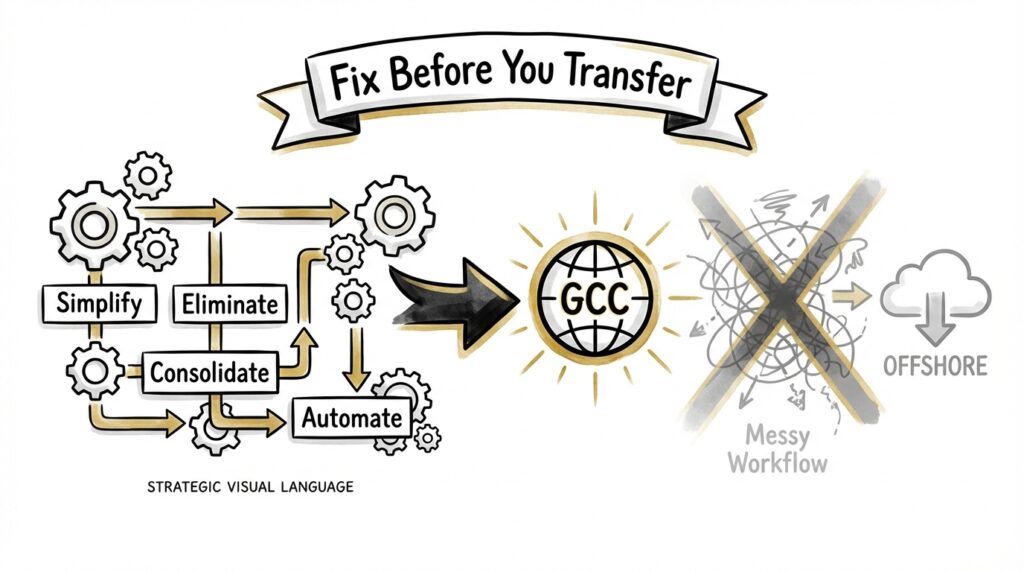
They treat outsourcing as the starting point of efficiency rather than the final stage of operational design.
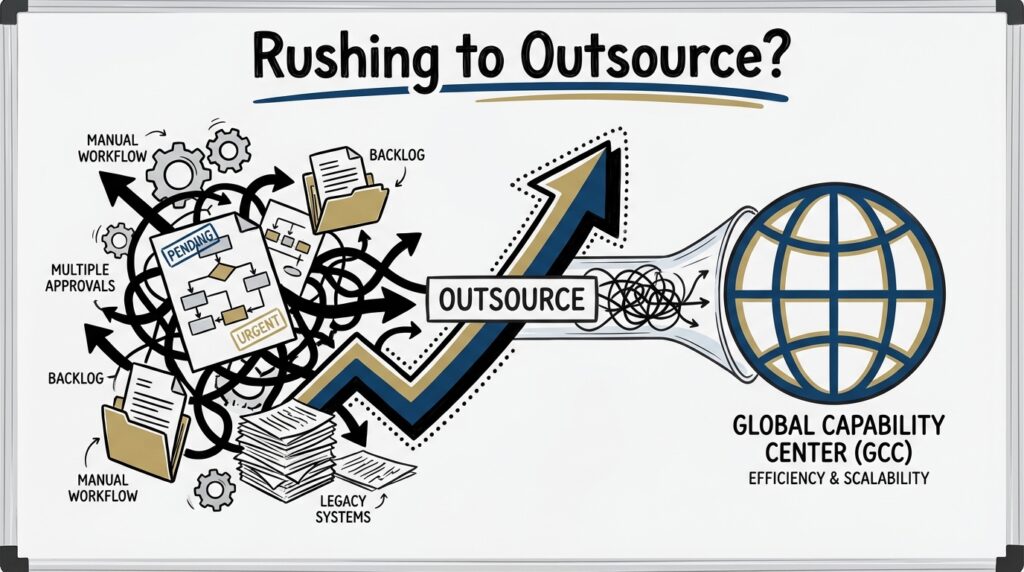
When that happens, companies do not eliminate inefficiency. They simply move it somewhere else.
Over time, this approach creates unintended consequences: operational confusion travels downstream, knowledge transfer becomes difficult, and the GCC ends up inheriting processes that were never designed properly in the first place.
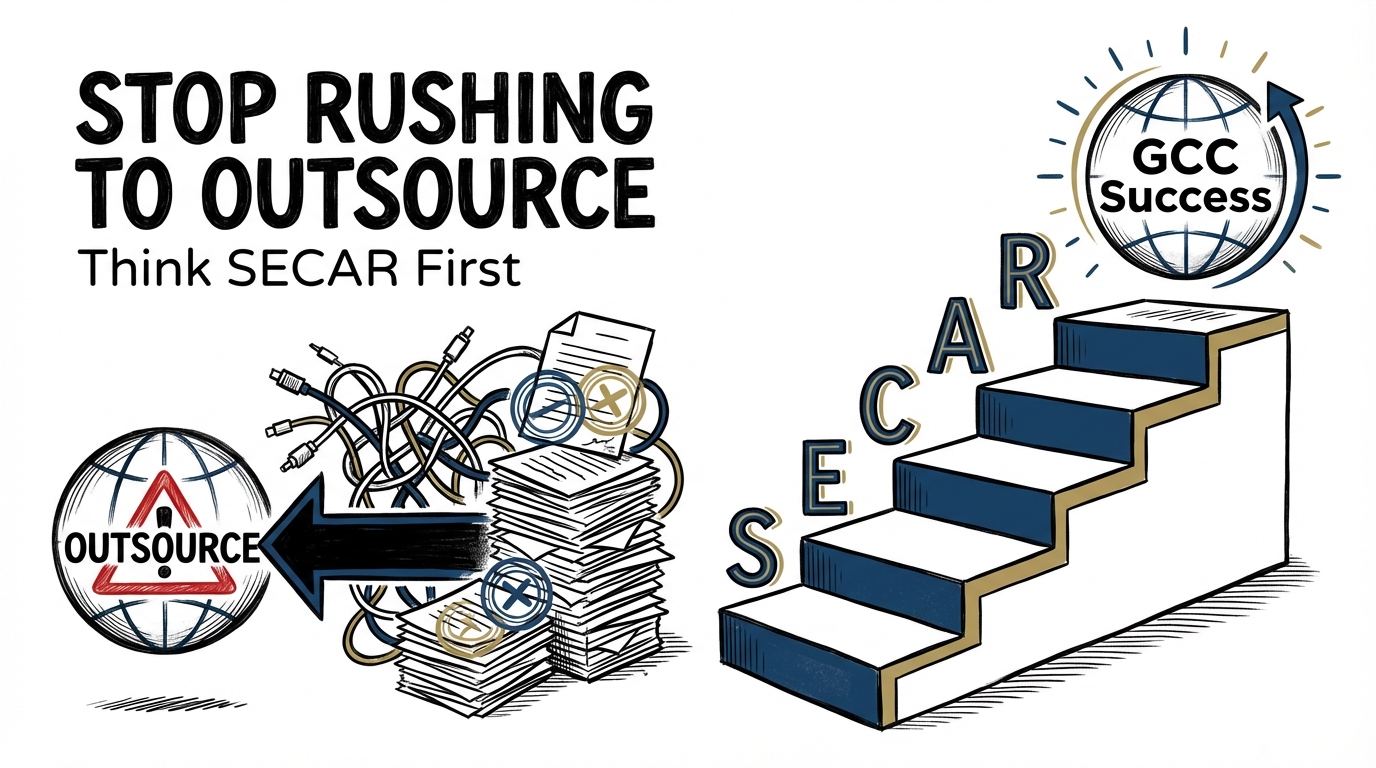
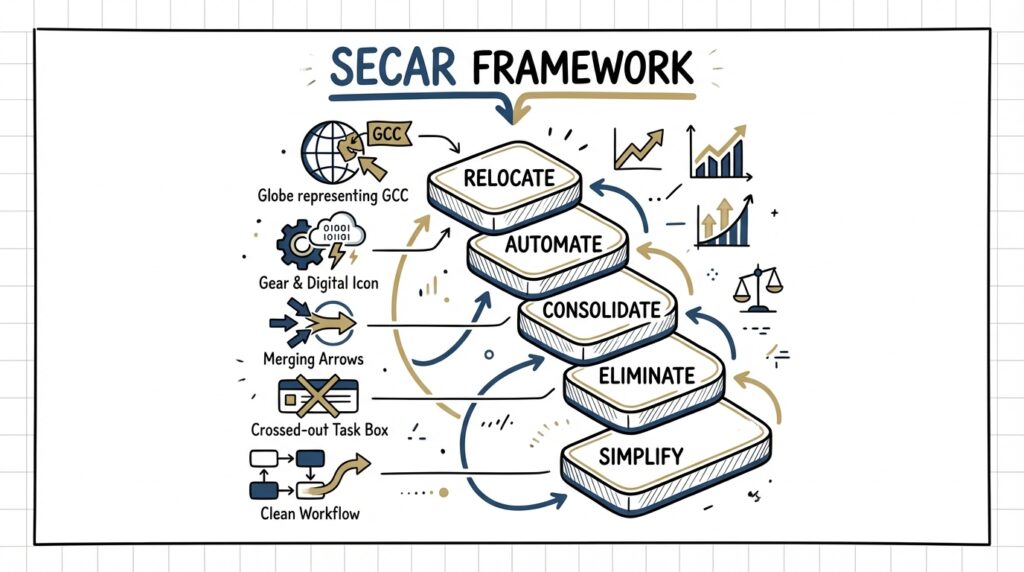
This is where a structured decision lens becomes critical. At CGH, we advocate evaluating operational efficiency through a simple but powerful framework called SECAR.
Why Rushing to Outsource Can Backfire
Outsourcing is often viewed primarily as a cost lever. In many cases, that assumption is correct — relocating work to lower-cost markets can significantly improve cost structures.
However, when outsourcing is used as the first solution, organizations frequently encounter several problems:
1. Inefficiencies Are Exported Instead of Solved
If a process is overly complex, fragmented, or poorly documented, transferring it to another location does not fix the underlying issue. It simply shifts the burden of understanding and repairing that complexity.
2. Knowledge Transfer Becomes Difficult
When workflows are unclear, offshore teams must spend significant time deciphering how things actually work. This delays productivity and erodes the cost advantages that outsourcing was supposed to create.
On a side note, many professionals also struggle with positioning their professional profiles effectively in the job market. If you are navigating career transitions, you may find this blog helpful. How to Fix Your Resume & LinkedIn for Better Interview Calls
3. GCCs Become Transactional Centers
When organizations continuously move low-value or poorly designed processes offshore, the GCC gradually becomes associated with repetitive operational tasks rather than strategic capabilities.
Over time, this weakens the perception of the center’s potential.
Instead of becoming a hub for transformation, analytics, or innovation, the GCC becomes a cleanup operation.
The real issue, however, is not geography.
It is sequence. Efficiency initiatives should follow a structured order — and that is exactly what the SECAR framework provides.
If you prefer a visual explanation of the SECAR framework and how it applies to outsourcing decisions, you can watch the full breakdown below
If you find insights like this useful, consider subscribing to the CGH YouTube channel where we share structured frameworks for corporate professionals – Subscribe to the CGH YouTube Channel
The SECAR Framework
SECAR is a practical model for evaluating operational improvement before deciding to outsource or relocate work.
The acronym represents five stages:
S – Simplify
E – Eliminate
C – Consolidate
A – Automate
R – Relocate
Each step ensures that the organization extracts incremental efficiency before moving to the next stage.
Only after completing the earlier phases should relocation or outsourcing be considered. Let us examine each component in detail.
S – Simplify
Operational complexity rarely appears overnight. It usually accumulates gradually as organizations evolve.
New approvals get added.
Exception processes emerge.
Additional reports are created.
Temporary workarounds become permanent procedures.
Over time, workflows that were originally simple become layered and difficult to navigate.
Simplification is about stepping back and asking fundamental questions:
- Are all these steps actually necessary?
- Are approvals duplicated across teams?
- Are different departments following slightly different versions of the same process?
- Have legacy requirements continued long after their relevance disappeared?
By redesigning processes with clarity and simplicity in mind, organizations often unlock immediate efficiency gains.
More importantly, simplification prevents unnecessary complexity from being transferred downstream. If work eventually moves to a GCC, it should arrive in a clean, logical form — not as a tangled workflow that requires months of clarification.
E – Eliminate
The next stage involves a question that many organizations rarely ask:
Does this activity need to exist at all?
Corporate environments frequently generate outputs that are maintained purely out of habit.
Reports continue to be produced long after decision-makers stop using them.
Manual checks remain in place even when system controls already exist.
Reconciliations are performed because they were required years ago.
Activity is often mistaken for productivity.
Elimination requires evaluating the true value of each task:
- Who consumes the output?
- What decision does it influence?
- What risk does it mitigate?
If the answer is unclear, the activity may not be necessary.
Removing low-value work reduces operational load permanently. It also prevents organizations from scaling unnecessary effort across locations. Outsourcing something that should never have existed in the first place is not efficiency — it is simply institutionalizing waste.
C – Consolidate
Many organizations suffer from operational fragmentation.
Different teams perform similar activities in slightly different ways. Multiple systems track overlapping information. Separate business units maintain parallel processes for tasks that could easily be standardized.
Consolidation focuses on bringing these scattered activities together.
This might involve:
- Centralizing similar functions under one team
- Standardizing reporting formats
- Aligning governance structures
- Reducing duplication across departments
When processes are consolidated, several benefits emerge:
- Greater transparency
- Stronger controls
- Improved scalability
- Better utilization of resources
For organizations considering a GCC model, consolidation is particularly important. Relocating fragmented processes often creates confusion for offshore teams. Consolidation ensures that what is transferred is structured and consistent.
A – Automate
Once processes have been simplified, unnecessary tasks removed, and structures consolidated, organizations are ready to explore automation.
Automation can take many forms, including:
- Workflow tools
- Robotic Process Automation (RPA)
- System integrations
- AI-assisted validation
- Standardized templates
However, automation should never be the first step.
Automating a flawed process simply accelerates inefficiency.
When the earlier SECAR stages are completed first, automation becomes far more effective because it operates on processes that are already clean and standardized.
At this point, automation often reduces manual effort significantly and creates predictable workflows that can be managed at scale. Interestingly, some organizations discover that after automation, the remaining workload becomes small enough that relocation is no longer necessary.
R – Relocate
Relocation — including outsourcing, offshoring, or transferring work to a Global Capability Center — is the final stage of the framework.
By the time this step is reached, the process being transferred should already be:
- Simplified
- Cleansed of unnecessary activities
- Consolidated into a consistent structure
- Partially or fully automated
This dramatically improves the success of relocation initiatives.
Instead of inheriting complexity, the receiving team gains a well-designed operating model that can be executed efficiently from day one.
In this scenario, the GCC does not merely act as a cost center. It evolves into a capability center — supporting transformation, analytics, and operational excellence across the organization.
The Real Advantage of Structured Sequencing
The primary benefit of the SECAR approach lies in sequencing.
Organizations that skip directly to relocation often face months of stabilization as offshore teams try to understand messy processes.
During this time:
- Efficiency gains are delayed
- Costs remain higher than expected
- Teams become frustrated on both sides
In contrast, companies that follow a structured approach transfer only well-designed processes. This accelerates onboarding, improves productivity, and preserves the cost benefits that outsourcing was meant to deliver.
Final Thoughts: Fix Before You Transfer
Outsourcing remains a powerful tool in modern operating models. GCCs, shared services, and global delivery networks have helped organizations scale capabilities and optimize costs.
But relocation should not be the first lever pulled in an efficiency initiative.
Before transferring work, organizations should pause and ask:
- Can the process be simplified?
- Are there tasks that should be eliminated entirely?
- Can fragmented activities be consolidated?
- Is automation possible?
Only after exploring these opportunities should relocation be considered.
Efficiency achieved through thoughtful design is far more sustainable than efficiency achieved through geography alone.
In the end, successful operational strategy is not about moving work faster.
It is about designing work better before deciding where it should live. And that is the discipline the SECAR framework brings to the table.
If you enjoy structured frameworks for navigating corporate challenges, explore more insights on the CGH blog – Browse all CGH Articles