
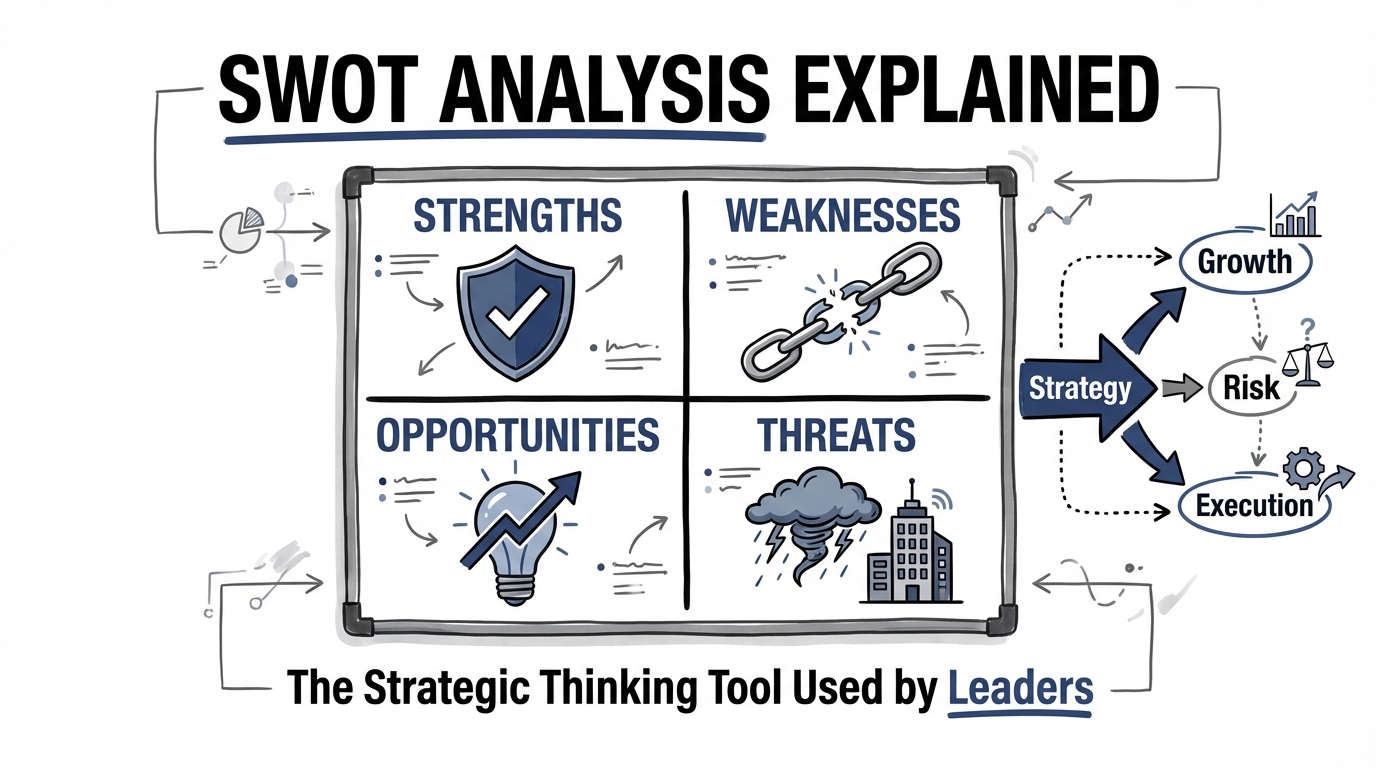
In the world of business strategy, some tools are complex and analytical, while others are deceptively simple. SWOT Analysis belongs to the latter category.
At first glance, SWOT appears to be a straightforward framework consisting of four quadrants. However, when applied correctly, it becomes a powerful strategic thinking tool used by organizations, leadership teams, consultants, and managers to evaluate decisions before committing resources.
From evaluating business strategy and market expansion to improving team performance and operational processes, SWOT analysis provides a structured way to analyze a situation from multiple perspectives.
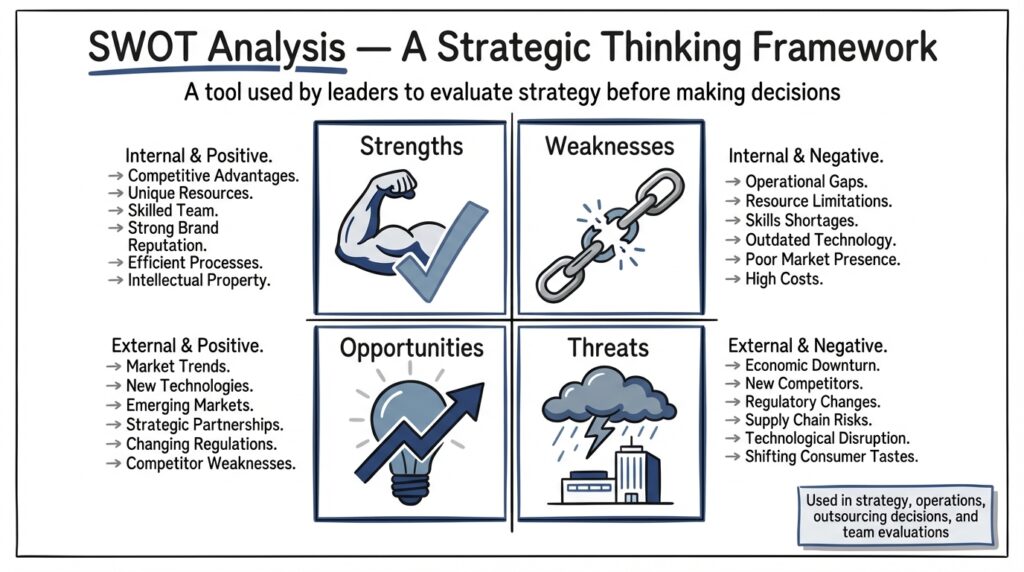
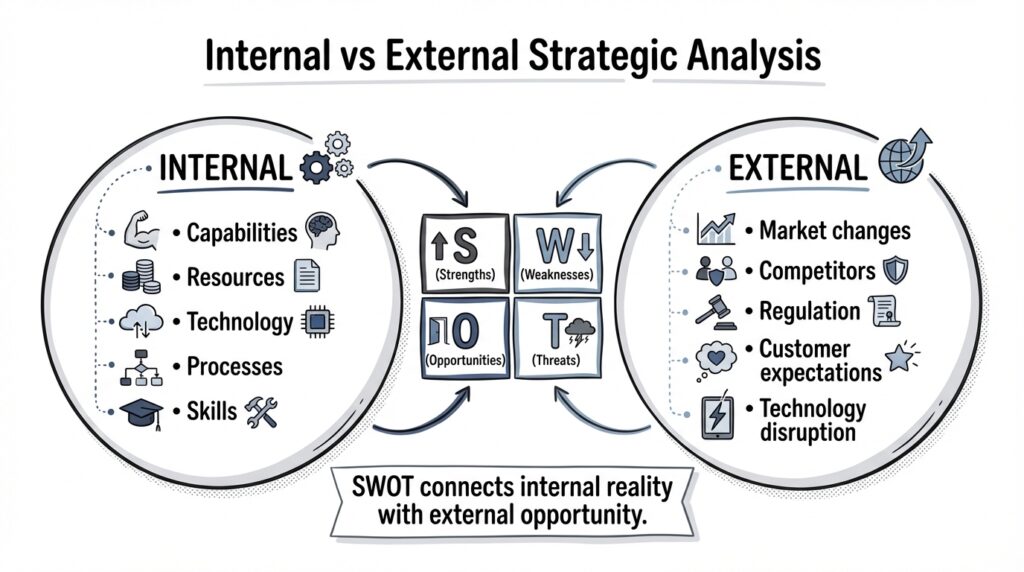
Visual summary of the SWOT analysis framework used in strategic planning
In this article, we explore:
- What SWOT analysis is
- Why organizations conduct SWOT analysis
- The meaning and significance of each component of SWOT
- How SWOT can be used beyond corporate strategy
- How leaders can apply SWOT to improve teams and processes
Understanding this framework can significantly improve the quality of strategic decisions.
If you prefer a visual explanation, you can watch the complete breakdown of SWOT Analysis in the video below
What is SWOT Analysis?
SWOT Analysis is a strategic planning framework used to evaluate a situation by examining four critical dimensions:
- Strengths
- Weaknesses
- Opportunities
- Threats
These four factors help organizations understand both their internal capabilities and the external environment in which they operate.
The framework divides analysis into two broad categories.
Internal Factors
These are elements that exist within the organization’s control.
They include:
- Resources
- Capabilities
- Systems
- Skills
- Technology
- Organizational culture
Strengths and weaknesses fall into this category.
External Factors
These are forces outside the organization’s direct control.
They typically include:
- Market dynamics
- Competitive landscape
- Technological shifts
- Regulatory environment
- Economic conditions
- Customer expectations
Opportunities and threats arise from these external conditions. By examining both internal and external factors simultaneously, SWOT analysis provides a balanced view of a strategic situation.
Why SWOT Analysis is Important in Strategic Decision Making
Organizations frequently face complex decisions:
- Should we enter a new market?
- Should we outsource certain functions?
- Should we invest in new technology?
- Should we restructure our teams?
- Should we launch a new product or service?
Without a structured framework, decision-making often becomes reactive or driven by intuition. SWOT analysis helps introduce discipline into strategic thinking.
Encourages Honest Internal Evaluation
One of the most valuable aspects of SWOT analysis is that it forces organizations to evaluate themselves realistically.
Teams must assess:
- What capabilities truly differentiate them
- Where operational gaps exist
- What limitations may hinder growth
This level of reflection often reveals insights that may otherwise remain hidden.
Identifies Opportunities in a Changing Environment
Markets are constantly evolving. New technologies emerge, customer expectations shift, and competitive dynamics change. SWOT analysis helps organizations systematically scan their environment to identify potential opportunities for growth.
Anticipates Risks Before They Become Problems
Threats rarely appear suddenly. Most disruptions give early signals. Through structured external analysis, organizations can identify risks early and develop mitigation strategies before those risks impact operations.
Understanding the Four Components of SWOT Analysis
To fully benefit from SWOT analysis, it is important to understand each component in depth.
Strengths: Internal Capabilities That Create Advantage
Strengths represent the internal capabilities that provide an organization with a competitive advantage.
These strengths can take many forms.
Common examples include:
- A strong brand reputation
- Highly skilled workforce
- Efficient operational processes
- Proprietary technology
- Strong leadership and governance
- Established customer relationships
However, a common mistake organizations make is confusing activity with strength.
Just because an organization performs a certain activity does not necessarily mean it is a strength.
A true strength is something that:
- Consistently delivers superior results
- Creates differentiation in the market
- Is difficult for competitors to replicate
Identifying genuine strengths helps organizations understand what capabilities they should leverage when pursuing growth opportunities.
Weaknesses: Internal Limitations That Require Attention
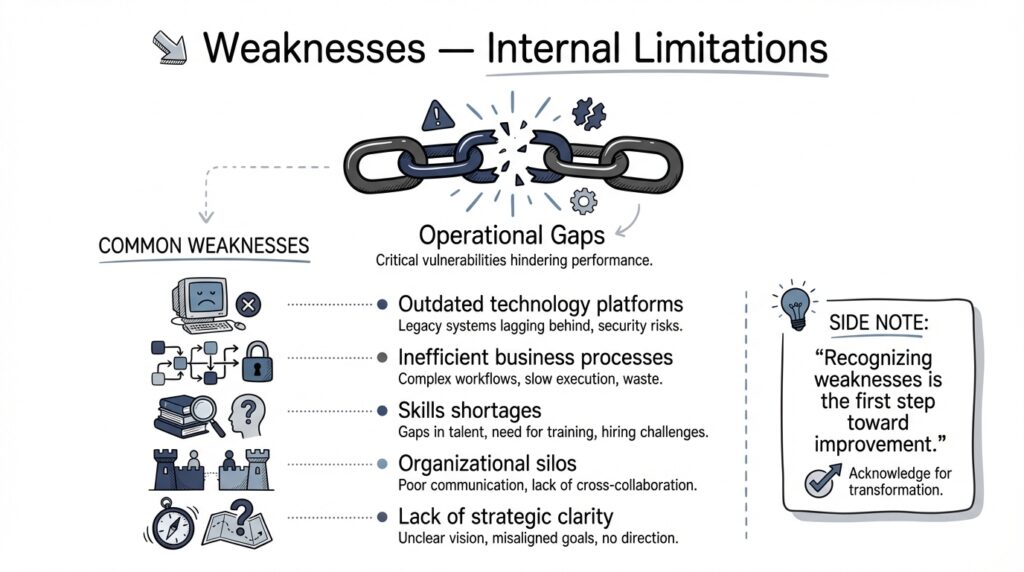
Weaknesses represent internal constraints that limit performance or create operational inefficiencies.
These weaknesses can manifest in several ways.
Examples include:
- Outdated technology infrastructure
- Inefficient operational processes
- Skill gaps within teams
- Lack of strategic alignment
- Poor communication across departments
- Limited access to capital or resources
Acknowledging weaknesses can be uncomfortable for organizations. However, identifying weaknesses is not about assigning blame.
It is about gaining clarity.
Organizations that openly recognize their limitations are better positioned to address them before they evolve into larger operational challenges.
Opportunities: External Factors That Enable Growth
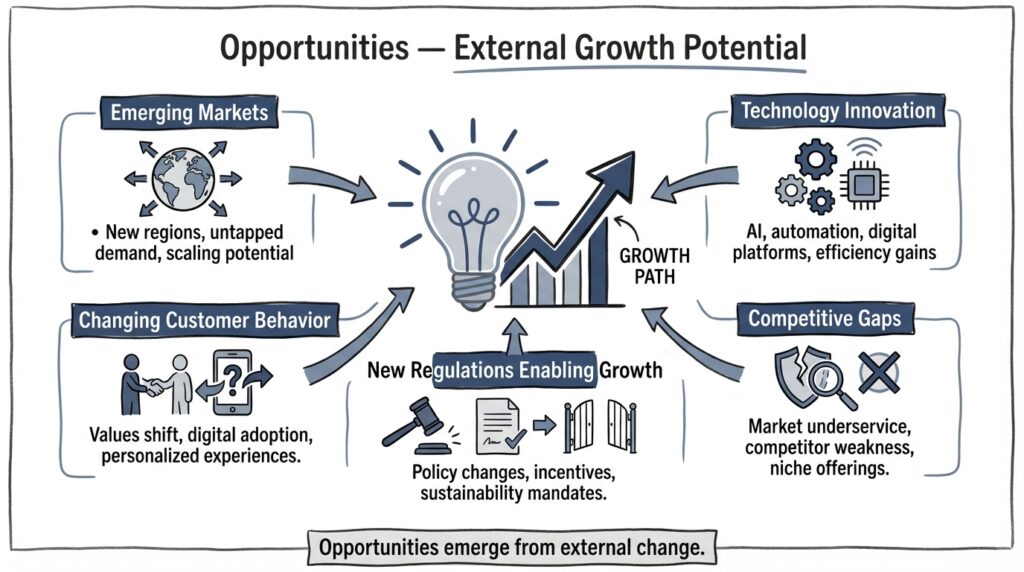
Opportunities arise from changes in the external environment that organizations can leverage for growth.
These opportunities may emerge from various sources.
Examples include:
- Expansion into emerging markets
- Technological advancements
- Changing customer preferences
- Industry consolidation
- Regulatory changes that open new sectors
- Competitor weaknesses
One of the most important leadership capabilities is the ability to recognize opportunities early.
Often, opportunities do not appear as obvious breakthroughs. Instead, they emerge gradually through subtle changes in the market environment.
Organizations that actively monitor industry trends are better positioned to identify and capitalize on these opportunities.
Threats: External Risks That Could Impact the Organization
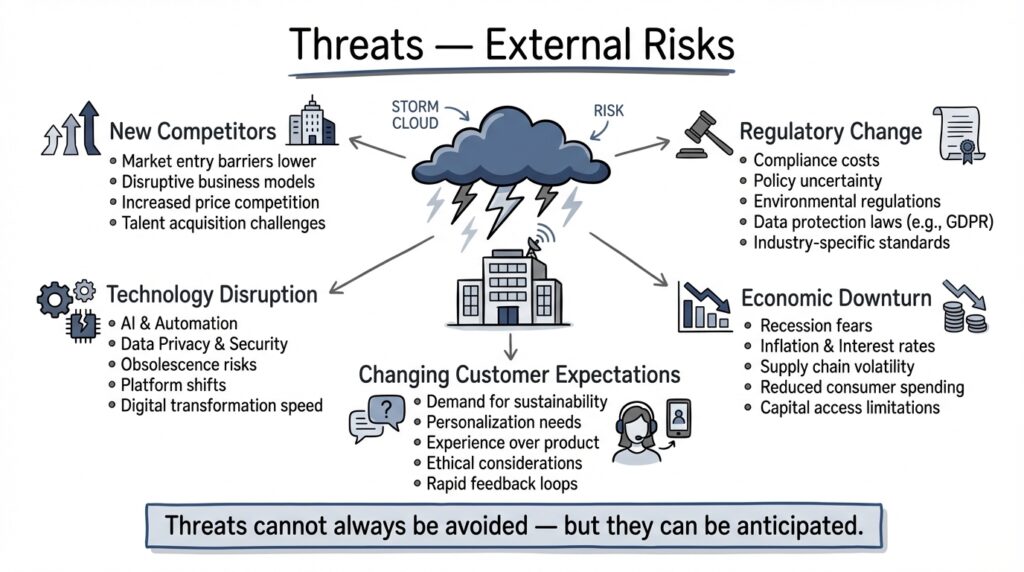
Threats represent external factors that could negatively affect an organization’s performance or strategic position.
These threats may include:
- Increasing competition
- Technological disruption
- Regulatory changes
- Economic downturns
- Supply chain instability
- Changing consumer behavior
While organizations cannot always eliminate threats, they can prepare for them.
Early recognition of threats allows leadership teams to develop contingency plans and adapt their strategies accordingly.
Strategic resilience often depends on how early an organization identifies potential risks.
SWOT Analysis Beyond Corporate Strategy
Although SWOT analysis is commonly associated with corporate strategy planning, its application extends far beyond organizational decision-making.
In practice, SWOT analysis can be applied at multiple levels.
SWOT Analysis for Teams
Team leaders can use SWOT analysis to evaluate team performance and identify opportunities for improvement.
A team-level SWOT analysis might examine:
Strengths:
- Core competencies of team members
- Experience and expertise
- Collaboration and communication effectiveness
Weaknesses:
- Skill gaps
- Resource limitations
- Inefficient workflows
Opportunities:
- Training programs
- Technology tools
- Process improvements
Threats:
- High workload
- Employee turnover
- External dependencies affecting performance
Conducting such an analysis helps leaders build stronger and more capable teams.
SWOT Analysis for Business Processes
Operations leaders can also apply SWOT analysis to evaluate and improve business processes.
For example, a process-level SWOT analysis may identify:
Strengths:
- Efficient workflows
- Well-defined procedures
- Automation capabilities
Weaknesses:
- Bottlenecks
- Manual dependencies
- Lack of scalability
Opportunities:
- Automation
- Technology integration
- Process standardization
Threats:
- Operational risks
- Compliance challenges
- Vendor dependencies
Using SWOT in this way enables organizations to identify opportunities to streamline operations and improve efficiency.
Once you conduct the SWOT, it empowers you to say NO to projects that might not be in the current capabilities of your processes. However, saying NO is not a straightforward task and requires a calm cool mind. We have covered the same in one of our earlier blog about How to say No. You can refer to the same.
Best Practices for Conducting an Effective SWOT Analysis
To extract meaningful insights from SWOT analysis, organizations should follow a few key principles.
Focus on clarity and honesty
The effectiveness of SWOT analysis depends on the accuracy of the information being evaluated. Honest assessment is essential.
Use diverse perspectives
Including multiple stakeholders often leads to more balanced insights. Leaders, managers, and operational teams may each see different aspects of the organization.
Connect SWOT insights to action SWOT analysis should not end with a framework on paper. The insights should lead to clear actions, such as strengthening capabilities, addressing weaknesses, or pursuing new opportunities.
On a side note, to help professionals get prepared for the challenges they face we have designed several checklists, download practical strategy checklists from our resource section designed for professionals
Final Thoughts
In business strategy, some frameworks endure for decades because of their simplicity and practical value.
SWOT analysis is one such framework.
Despite its straightforward structure, it provides a powerful way to analyze situations, evaluate decisions, and improve strategic clarity.
Whether applied to corporate strategy, team management, or operational improvement, SWOT analysis encourages structured thinking and balanced evaluation.
In an increasingly complex business environment, leaders who take the time to step back, assess their capabilities, and evaluate their external environment often make more informed decisions. And sometimes, the most powerful strategic insights begin with something as simple as drawing four boxes on a blank page.
If you want to explore more business framework than do refer to our SECAR framework blog.
Frequently Asked Questions About SWOT Analysis
What is SWOT Analysis in business?
SWOT Analysis is a strategic planning framework used by organizations to evaluate four key factors: strengths, weaknesses, opportunities, and threats.
Strengths and weaknesses represent internal factors within the organization, such as capabilities, resources, and operational processes.
Opportunities and threats represent external factors such as market trends, competition, regulatory changes, and technological developments.
By analyzing these four elements together, organizations gain a balanced understanding of their current position and can make better strategic decisions.
What are the four components of SWOT Analysis?
The four components of SWOT Analysis include:
Strengths: Internal capabilities that provide competitive advantage.
Weaknesses: Internal limitations that may hinder performance.
Opportunities: External conditions that could enable growth.
Threats: External risks that may negatively impact the organization.
These four dimensions help organizations evaluate both internal performance and external market dynamics.
Why is SWOT Analysis important for strategic planning?
SWOT Analysis is important because it provides a structured framework for evaluating strategic decisions.
It helps organizations identify their competitive advantages, recognize operational weaknesses, uncover potential growth opportunities, and anticipate external risks.
This balanced assessment allows leadership teams to develop strategies that leverage strengths, address weaknesses, capitalize on opportunities, and prepare for potential threats.
Can SWOT Analysis be used for teams and processes?
Yes. Although SWOT analysis is commonly used for business strategy, it can also be applied to teams and operational processes.
For example, leaders may conduct a team SWOT analysis to evaluate team capabilities, identify skill gaps, and explore opportunities for training and development.
Similarly, operations leaders may use SWOT analysis to assess process efficiency, identify bottlenecks, and explore opportunities for automation or improvement.
How often should organizations conduct SWOT Analysis?
Organizations typically conduct SWOT analysis during strategic planning cycles, business reviews, or before major strategic decisions.
However, many organizations also perform SWOT analysis periodically to reassess their position in changing market environments.
Regular SWOT reviews help organizations stay responsive to new opportunities and emerging threats.
For more insights on business strategy, leadership thinking, and practical frameworks used in corporate environments, explore the CGH YouTube Channel for strategic insights.