
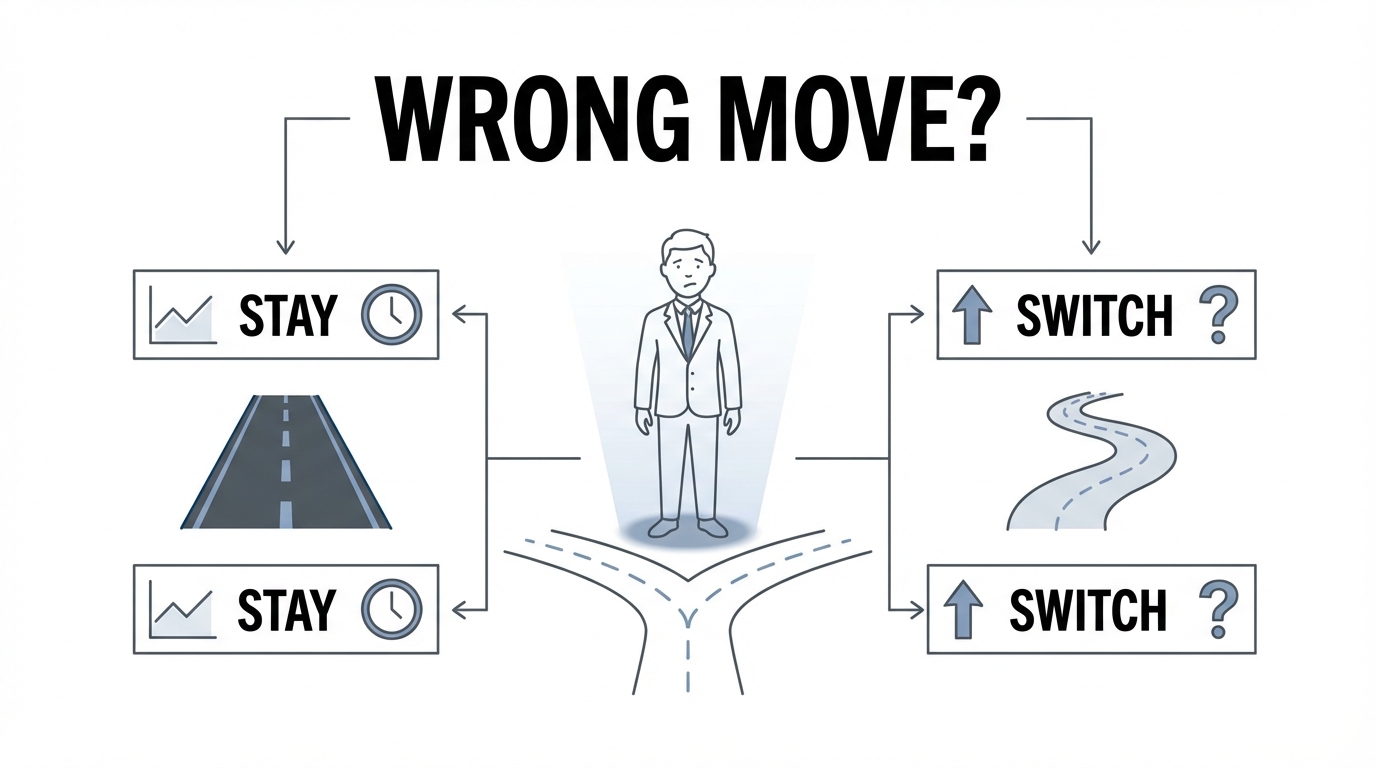
At some point in your career, you will face a deceptively simple question:
Should you stay in your current role… or switch?
Most professionals believe this decision depends on salary, title, or company brand.
But that’s surface-level thinking.
Because the real risk is not making a bad decision —
It’s making a decision based on the wrong signals.
This is where most careers quietly lose momentum.
If you are interested in watching a video for full understanding, you can view it below.
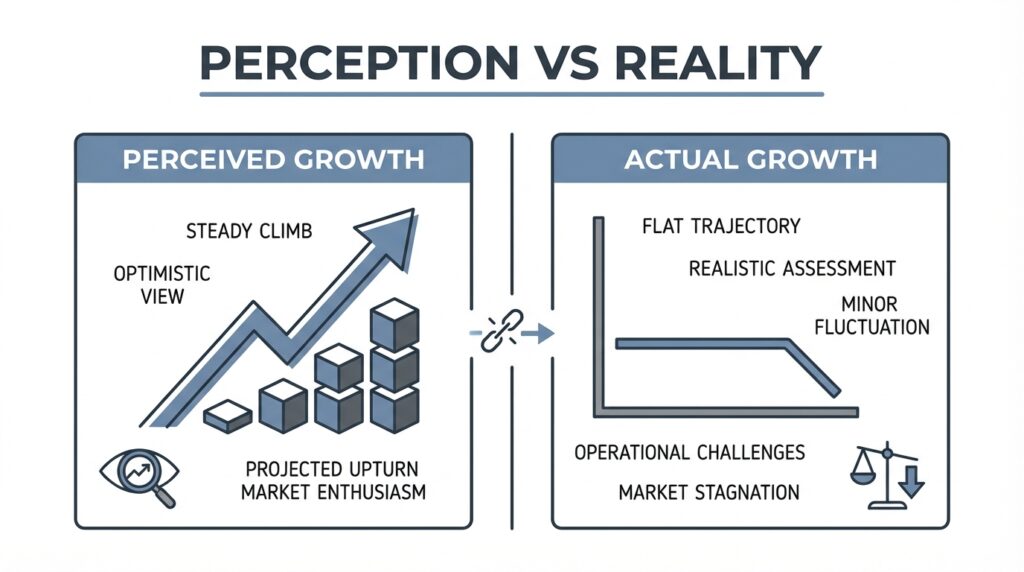
The Real Problem: Misreading Growth
Many professionals assume they are growing because:
- They are busy
- They are performing well
- They are comfortable
But none of these guarantee growth.
In fact, comfort is often the biggest illusion in a career.
Because what feels like stability is often stagnation in disguise.
Careers Don’t Grow Linearly
One of the biggest misconceptions about careers is that they grow steadily over time.
They don’t.
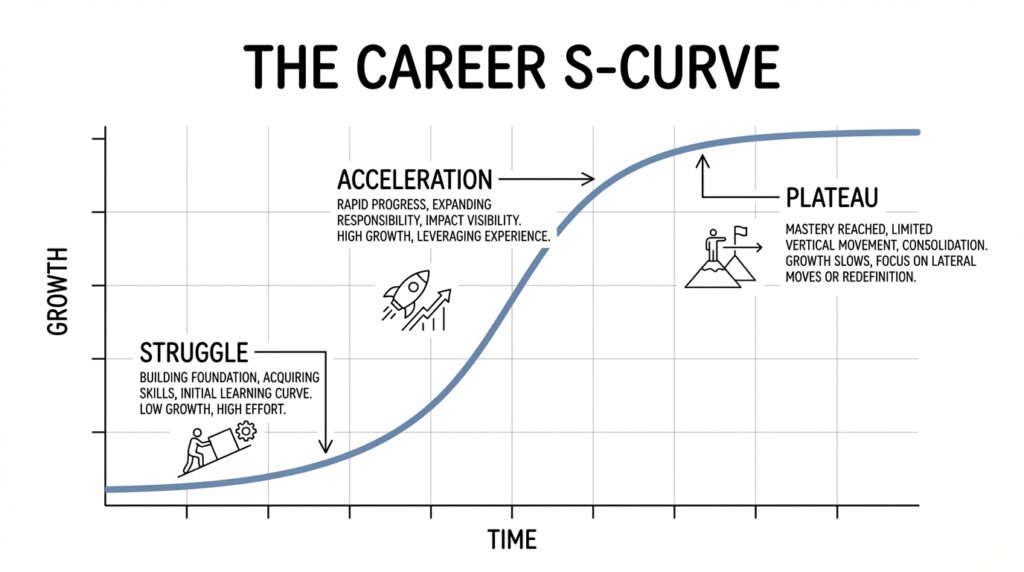
Careers evolve in phases of acceleration followed by plateaus.
The Career S-Curve
Every meaningful role follows a predictable pattern:
- Phase 1: Struggle
You are learning, adapting, and figuring things out - Phase 2: Acceleration
Your output improves, confidence builds, and visibility increases - Phase 3: Plateau
The environment becomes predictable, and growth slows down
The danger?
Plateau doesn’t feel like failure. It feels like control.
And that’s where most professionals get stuck for years.
The 3 Career States You Must Recognize
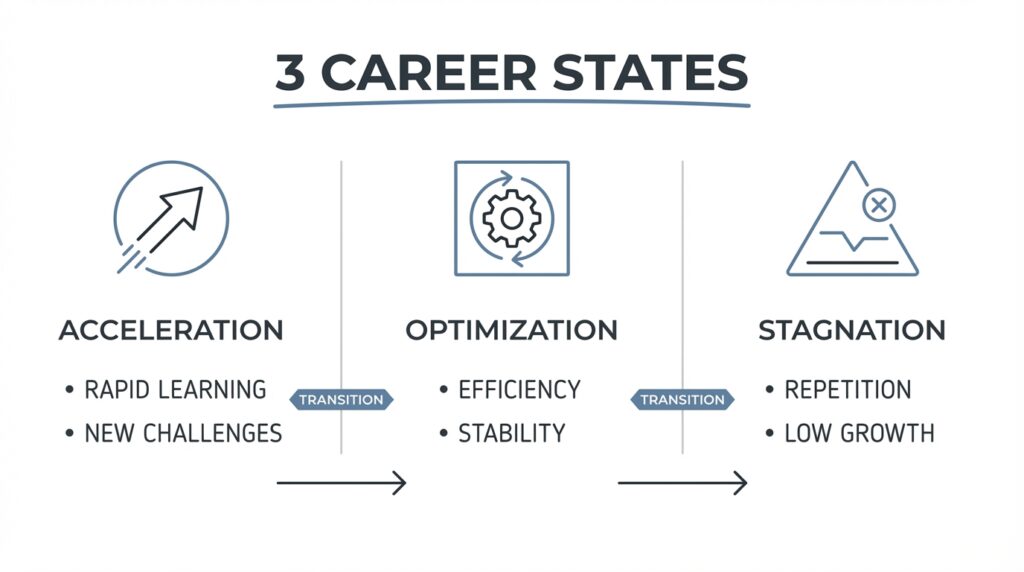
At any given point, you are operating in one of three states:
1. Acceleration
- Rapid learning
- Exposure to new challenges
- Expanding thinking
This is where real career growth happens.
2. Optimization
- Improved efficiency
- Consistent performance
- Familiar problem-solving
This phase is useful — but temporary.
3. Stagnation
- Repetitive work
- Minimal learning
- Limited exposure
This is where careers begin to flatten.
The Critical Mistake
Most professionals confuse optimization with growth.
Because both feel productive.
But only one moves your career forward.
When You Should Stay in Your Role
Staying is not about loyalty.
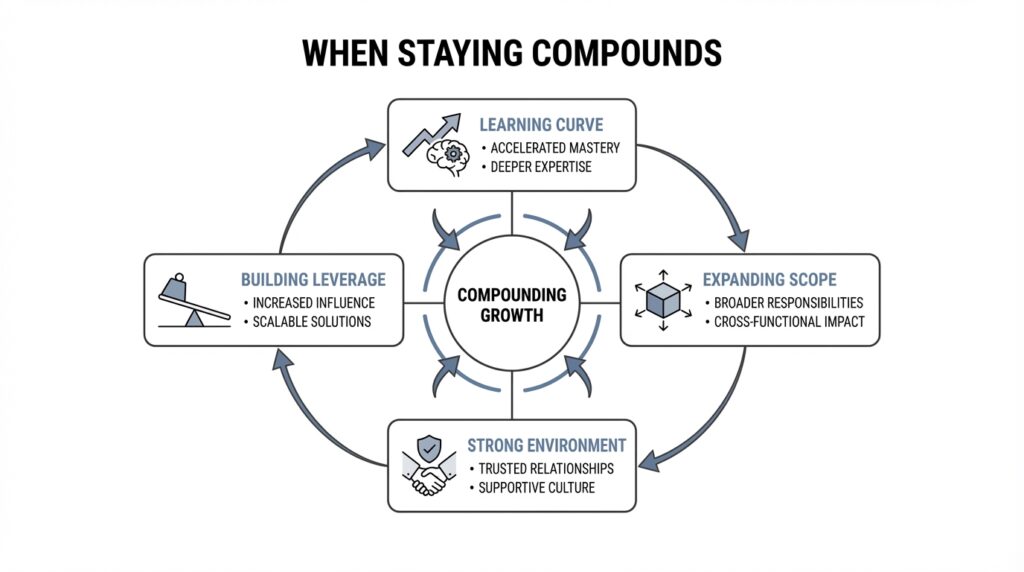
It’s about compounding growth.
You should stay when your current role is still accelerating your trajectory.
1. You Are Still Learning at a High Rate
If your role continues to challenge you and push your thinking, you are still growing.
Discomfort is a signal — not a problem.
2. Your Scope Is Expanding
Look for signs like:
- Increased ownership
- Broader responsibilities
- Exposure to decision-making
Scope expansion is one of the strongest indicators of growth.
3. You Are Building High-Value Capabilities
Ask yourself:
“If I leave today, what valuable skills do I take with me?”
If the answer is meaningful, your role is still compounding your future.
4. You Are Surrounded by Strong Learning Environments
Growth is shaped by:
- The quality of people around you
- The feedback you receive
- The problems you are exposed to
Careers are built in environments — not in isolation.
5. You Are Building Leverage, Not Just Experience
There is a critical difference between:
- Doing more work
- Becoming more valuable
Leverage comes from:
- Owning outcomes
- Making decisions
- Influencing direction
If your role is increasing your leverage — stay.
When You Should Switch Roles
Switching is not about escaping discomfort.
It’s about restarting your growth curve.
1. Your Learning Has Plateaued
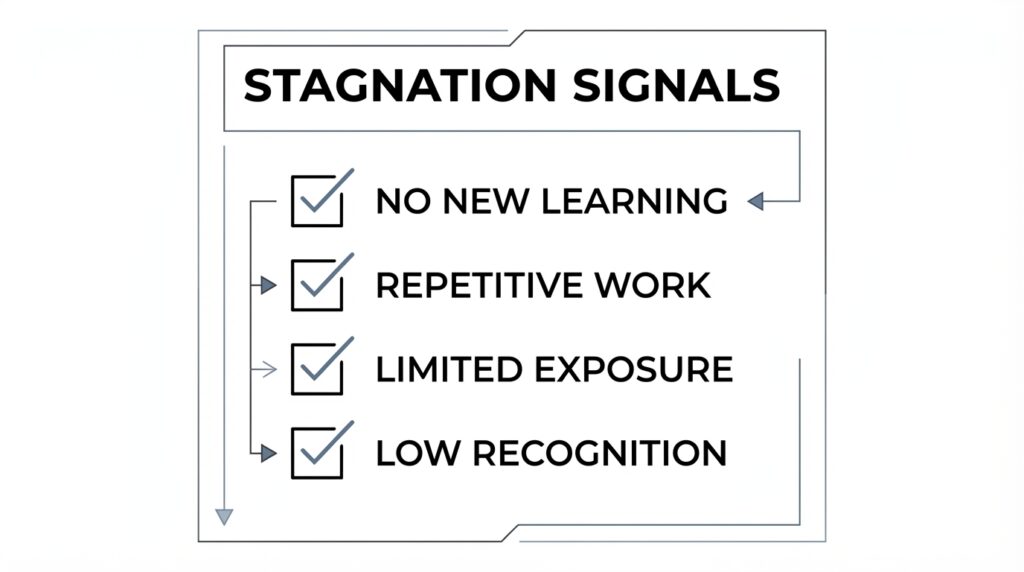
If you are no longer challenged or stretched, your growth has slowed.
This is the first signal to reassess your role.
2. Your Growth Is Blocked, Not Delayed
There’s a difference between:
- “Not yet”
- “Not here”
If your current environment cannot support your next level, waiting will not solve the problem.
3. Your Role Has Become Repetitive
Solving the same problems repeatedly does not build meaningful growth.
It builds familiarity — not capability.
4. Your Impact Is Not Translating into Opportunity
If your contributions are not leading to:
- Increased responsibility
- Better opportunities
- Meaningful recognition
You may be in the wrong system.
5. You Are Staying Due to Comfort or Fear
Common signals include:
- Fear of uncertainty
- Reluctance to start over
- Preference for predictability
Comfort is not a long-term strategy.
6. You Are Caught in the Sunk Cost Trap
“I’ve already invested years here.”
But past investment does not determine future value.
The only relevant question is:
“Is this role still compounding my growth?”
In Today’s world switching roles is a very difficult task in itself. We at CGH do have a checklist that can help you in this search. Feel free to download your copy.
Experience vs Leverage: The Most Overlooked Insight
Most professionals optimize for experience.
But careers are built on leverage.
Experience
- Repetition
- Time spent
- Task execution
Leverage
- Decision-making
- Ownership
- Influence
Leverage scales your career.
Experience alone does not.
How to Switch Strategically (Not Emotionally)
Even when switching is the right decision, how you switch matters.
1. Switch for Learning, Not Just Salary
A higher salary with lower growth potential is a hidden cost.
2. Evaluate Roles Based on Trajectory
Ask:
- Will this role expose me to better problems?
- Will I work with better people?
- Will my thinking be stretched?
3. Avoid Lateral Comfort Moves
A new role that feels easier but offers the same challenge level is not progress.
It is repositioning.
4. Look for Asymmetric Opportunities
The best career moves offer:
- Limited downside
- High upside potential
These often come with ambiguity and ownership.
Once you have decided to make the switch, you are often faced with the challenge of winning your new team members. Our blog on this would a guide with practical steps to get over this initial hurdle,
A Simple Decision Framework: Stay or Switch
Before making your decision, ask yourself:
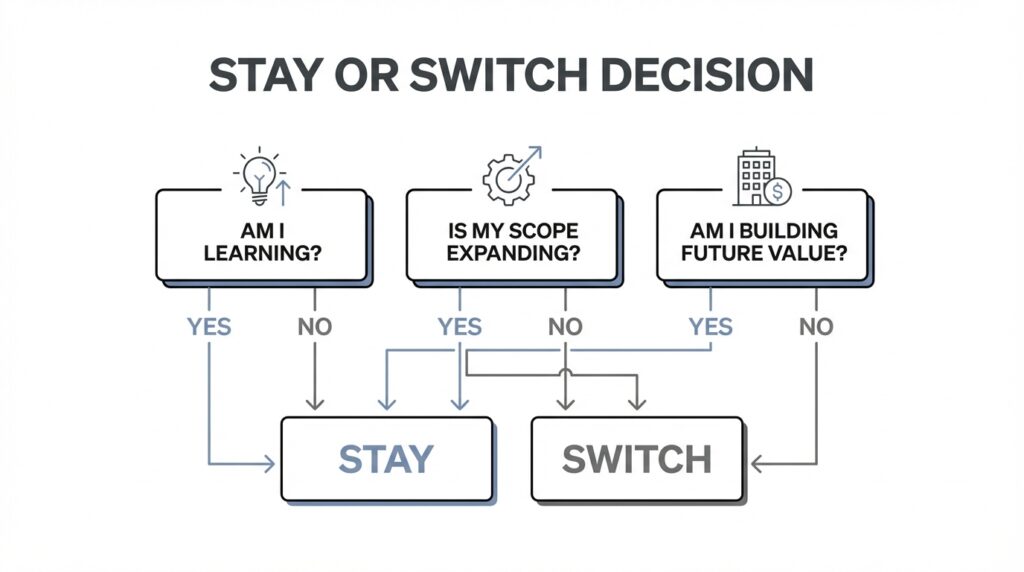
1. Am I still learning at a high rate?
2. Is my role expanding meaningfully?
3. Am I building capabilities that increase my future value?
Decision Rule
- If the answer is YES → Stay
- If the answer is NO → Switch
Final Thoughts: Optimize for Growth
Careers are not defined by how often you switch.
Or how long you stay.
They are defined by how well you understand:
When growth is happening — and when it has stopped.
So don’t optimize for comfort.
And don’t optimize for change.
Optimize for compounding growth.
Because in the long run:Growth is the only metric that truly compounds.
Follow us for more such informational videos on our YouTube channel.